
Source Catalog Agent: Use Cases & Domain Standards
Data within an enterprise is rarely uniform. Diverse systems use varying field names, structures, and update frequencies to describe identical business entities. The Source Catalog Agent bridges the gap between raw physical structures and standardized business definitions. This guide details how the agent addresses semantic drift, aligns schemas to domain standards, and supports critical enterprise use cases.
Core Use Cases
1. Enterprise Schema Normalization
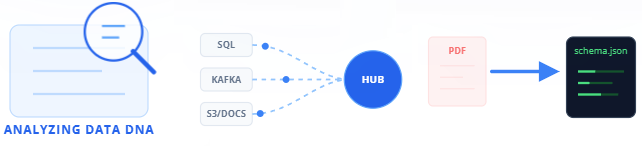
In organizations with hybrid infrastructures, data is ingested from relational platforms, message queues, and cloud storage files. The Source Catalog Agent normalizes this metadata into a single, standardized format:
- Relational Databases (JDBC/ODBC): Regularizes table definitions and column details from legacy relational engines.
- Streaming Topics (Apache Kafka / AMQP): Maps transient payload schemas, providing a unified structure alongside static tables.
- Cloud Files (Parquet / Avro / JSON): Converts nested schema attributes into flat, query-friendly structures.
- Dynamic Interfaces (REST API / Open Lineage): Translates live payload logs and run-time metadata events into standardized schema records.
2. Semantic Concept Alignment
A recurring issue in metadata management is identifying identical entities across multiple systems. For example, a customer identifier might be named:
customer_idinside a PostgreSQL table connected via JDBC.custIdinside an active Apache Kafka topic message.Client Identifierinside a raw JSON/AVRO configuration file or PDF spec.
The Source Catalog Agent resolves this by running semantic analysis on names and data shapes. It identifies that these fields represent the same entity, automatically grouping them in the metadata registry. This allows data engineers to trace lineages and establish security rules across databases, streams, and files concurrently.
3. Preventing Semantic Drift
Semantic drift occurs when different departments assign divergent definitions to the same database field. For instance, a field named user_status might be interpreted as:
- Engineering: A boolean indicating if an account has verified its email.
- Analytics: A status code tracking user activity inside a 30-day window.
- Finance: A tier classifying the account for billing purposes.
Without clear, shared standards, these definitions drift, leading to conflicting reporting metrics. The Source Catalog Agent prevents semantic drift by checking schemas against business definitions defined in wikis, data dictionaries, and catalog configurations. It attaches explicit, approved rules to technical schema columns, guaranteeing that all teams query the correct field.
Implementing Domain Standards Step-by-Step
The Source Catalog Agent enforces data consistency by applying domain standards directly to raw schemas.
Step 1: Ingesting Domain Rules
The agent imports business vocabularies, naming conventions, and privacy specifications from your enterprise data dictionaries or internal wiki systems.
Step 2: Running Metadata Analysis
During discovery runs, the agent compares physical data profiles against the imported domain rules:
- It checks if column names conform to naming standards (e.g. snake_case vs camelCase).
- It checks if data types match definitions (e.g. verifying that phone numbers are stored as strings rather than integers).
- It flags missing descriptions or missing classification categories.
Step 3: Resolving Structural Variances
When field structures vary across data formats (e.g., standard flat structures in JDBC vs deeply nested structures in JSON or Parquet files), the agent applies flattening and nesting rules. This creates a virtual schema representation that aligns both styles.
Step 4: Tagging Sensitive Information
The agent analyzes column profiles to automatically identify and tag sensitive data categories (such as GDPR PII or CCPA compliance fields), aligning them with organizational standards.
Benefits: What Makes It Good?
- Ensures Consistent Reporting: By eliminating semantic drift, the agent guarantees that business analysts, developers, and executives refer to identical metrics.
- Simplifies Migration: When moving workloads from legacy database systems to cloud repositories, the agent maps old and new structures, verifying that data shapes and meanings remain intact.
- Automates Compliance Guardrails: Automated tagging of sensitive fields ensures compliance audits can locate PII instantly across files, databases, and event streams.
- Bridges Team Silos: Unifies engineering, analysis, and business groups by replacing separate definitions with a single, clear terminology mapping.