
Data Engineer Support Agent: Architecture, Integrations, & Security
Modern enterprise data architectures require high security, broad platform connectivity, and seamless multi-agent cooperation. The Data Engineer Support Agent is designed to operate as a core pillar within the Datapunkt collaborative ecosystem, integrate directly with major cloud platforms and orchestration tools, and run within a strict zero-data-storage security sandbox that protects your infrastructure metadata, pipeline configurations, and business data at all times.
Multi-Agent Architecture & Cooperation
In the Datapunkt ecosystem, specialized agents work together under the Root Orchestrator to design, validate, deploy, optimize, and monitor data pipelines end-to-end. The Data Engineer Support Agent functions as the operational backbone, translating architectural designs and mapping contracts into deployable infrastructure, optimized queries, and debugged pipeline configurations.
The Agent Cooperation Pipeline
The following sequence illustrates how the Data Engineer Support Agent fits into the broader multi-agent pipeline:
Source Catalog Agent: Connects to physical data sources (e.g., PostgreSQL, MySQL, Oracle, APIs) and publishes detailed schema definitions, column metadata, and data profiling statistics to the shared catalog.
Data Modeling Agent: Ingests published source structures and constructs target schemas optimized for the destination warehouse architecture (such as Raw Vault, Star Schema, or analytical flat tables).
Mapping Contract Agent: Compares source schemas with target schemas and defines specific transformation rules, column mappings, data quality constraints, and business logic in a version-controlled YAML contract.
Transformation Agent: Reads the generated mapping contracts and executes physical data transformations using SQL, Python, dbt, SQLMesh, Dataform, or PySpark scripts.
Data Quality Agent: Analyzes data schemas, translates natural language quality rules into active validation logic, and monitors data streams for failures across seven key dimensions (INTEGRITY, TIMELINESS, COMPLETENESS, ACCURACY, CONSISTENCY, UNIQUENESS, and VALIDITY).
Synthetic Data Agent: Scans target schemas, implements PII DETECTION, applies ML SYNTHESIS and DIFFERENTIAL PRIVACY constraints, and generates high-fidelity synthetic datasets for testing and staging while maintaining perfect referential DATA INTEGRITY and SCHEMA FIDELITY.
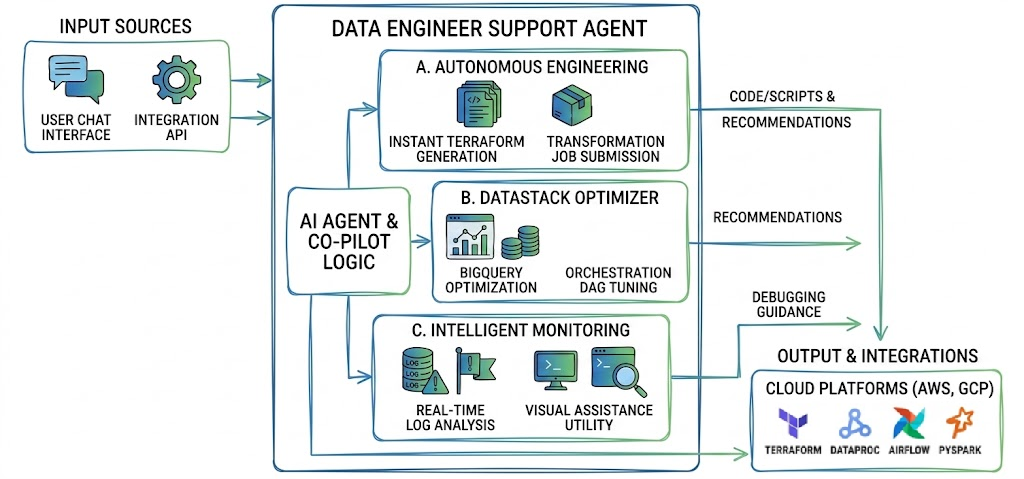
Data Engineer Support Agent (This Agent): Takes the schemas, mapping contracts, transformation definitions, and quality rules produced by upstream agents and translates them into deployable cloud infrastructure. Specifically, it:
- Generates production-ready Terraform modules for AWS and GCP that provision the compute clusters, storage buckets, warehouse tables, networking rules, and IAM policies required to run the pipeline.
- Optimizes existing BigQuery queries and Dataflow streaming configurations to minimize cloud cost and maximize throughput.
- Debugs failing PySpark jobs, Airflow DAGs, and Cloud Composer workflows in real time by analyzing executor logs, thread dumps, and memory profiles.
- Generates privacy-compliant synthetic test data using ML SYNTHESIS with DIFFERENTIAL PRIVACY noise guarantees, ensuring staging environments never expose production PII.
- Enforces GDPR/CCPA compliance across every generated artifact through data retention policies, consent-aware routing, and PII quarantine zones.
Data Lineage Agent: Gathers metadata from all agents, including the infrastructure modules, optimization reports, and debugging artifacts produced by the Data Engineer Support Agent, to compile a comprehensive column-level lineage graph spanning the entire pipeline.
How Multi-Agent Cooperation Works in Practice
When a new data source is onboarded, the cooperation pipeline executes as a coordinated sequence:
- The Source Catalog Agent discovers and profiles the source tables, publishing schema metadata.
- The Data Modeling Agent designs the target warehouse structure.
- The Mapping Contract Agent generates the transformation rules between source and target.
- The Data Engineer Support Agent receives these artifacts and automatically generates the cloud infrastructure (Terraform) needed to execute the pipeline, including compute clusters, storage permissions, and networking rules.
- The Transformation Agent executes the physical data movement using the provisioned infrastructure.
- The Data Quality Agent validates the output against the defined quality rules.
- The Synthetic Data Agent generates privacy-safe test copies for QA and development teams.
- The Data Engineer Support Agent monitors the running pipeline, optimizes slow queries, debugs executor failures, and generates diagnostic reports.
- The Data Lineage Agent traces the complete data flow from source to target, including all infrastructure and transformation steps.
This end-to-end automation eliminates manual handoffs, reduces human error, and ensures that every component of the pipeline is production-ready, performance-optimized, and privacy-compliant.
Platform & Tool Integrations
The Data Engineer Support Agent supports a comprehensive range of cloud platforms, data warehouses, orchestration frameworks, streaming engines, and collaboration tools.
Supported Cloud Platforms
- Google Cloud Platform (GCP): Generates Terraform modules for Dataproc clusters, BigQuery datasets and tables, Cloud Storage buckets, Cloud Composer environments, IAM service accounts, VPC networks, and Pub/Sub topics.
- Amazon Web Services (AWS): Generates Terraform modules for EMR clusters, Redshift warehouses, S3 buckets, MWAA (Managed Airflow) environments, IAM roles and policies, VPC configurations, and Kinesis streams.
- Microsoft Azure: Supports integration guidance for Azure Synapse Analytics, Azure Data Lake Storage (ADLS), Azure Data Factory, and Azure Databricks environments.
Supported Data Warehouses & Databases
- Cloud Warehouses: Google BigQuery, Amazon Redshift, Snowflake, and Databricks Lakehouse.
- Relational Databases: PostgreSQL, MySQL, Microsoft SQL Server, Oracle Database, and MariaDB.
- Storage Systems: Amazon S3, Google Cloud Storage (GCS), Azure Data Lake Storage (ADLS), and HDFS.
Orchestration & Processing Frameworks
- Apache Airflow / Cloud Composer: Analyzes, optimizes, and rewrites DAG definitions to eliminate bottlenecks, rebalance pool allocations, and add monitoring hooks.
- Apache Spark / PySpark: Debugs executor failures, analyzes JVM thread dumps, identifies data skew, and recommends optimal Spark submission parameters and cluster configurations.
- Google Dataflow / Apache Beam: Optimizes streaming window configurations, autoscaling policies, and worker machine types for cost-efficient real-time processing.
- dbt (data build tool): Integrates with dbt projects to validate generated SQL, test mapping logic, and ensure schema consistency across transformation layers.
- Prefect / Dagster: Supports integration patterns for modern orchestration frameworks, including task graph analysis and execution profiling.
Infrastructure-as-Code Tools
- Terraform (HashiCorp): Primary IaC generation target. The agent produces complete, modular
.tffiles with variables, outputs, provider configurations, and remote state backends. - Pulumi: Provides guidance and conversion support for teams using Pulumi's programmatic infrastructure definitions.
Collaboration & Communication Integrations
- Microsoft Teams & Slack: Connect the agent to your team communication channels to request infrastructure generation, trigger optimization analyses, receive debugging alerts, and share diagnostic reports. Contact support on the Datapunkt site to request setup tokens.
- Jira & Confluence: Generated diagnostic reports and optimization summaries can be formatted for direct import into Jira tickets or Confluence documentation pages.
Security, Privacy, and Data Protection
The Data Engineer Support Agent is engineered with security-first principles at every layer. We understand that infrastructure metadata, pipeline configurations, and database schemas are highly sensitive assets that require strict protection.
Zero-Data Storage Policy
A core security benefit of the Datapunkt architecture is that we do not store your operational data:
- The agent only processes metadata such as table schemas, DDL definitions, query execution plans, DAG configurations, and log stack traces provided directly by you during the session.
- The agent never accesses, queries, or stores your actual transactional data rows, customer records, financial data, or sensitive personal information.
- Your business data, infrastructure credentials, and pipeline source code remain entirely within your private network boundaries.
Transient In-Memory Processing
To prevent unauthorized access to infrastructure metadata, all analysis, code generation, and optimization operations execute transiently in memory:
- Terraform templates, query optimization results, DAG analysis reports, PII DETECTION flags, and log diagnostic findings are generated in real time during your active session.
- Once the session is closed, the in-memory processing cache is immediately cleared and purged.
- No infrastructure metadata, schema definitions, pipeline configurations, or generated artifacts are persisted on Datapunkt platform databases after session termination.
Encryption & Secure Access
- Transit Encryption: All communications between your systems, cloud platforms, orchestration tools, and the agent are protected using TLS 1.3 encryption with perfect forward secrecy.
- Credential Isolation: The agent operates using read-only inspection patterns. It analyzes schemas, logs, and configurations you provide but never directly connects to your production databases, cloud consoles, or orchestration platforms. All generated code is for you to review, modify, and execute manually.
- Session-Scoped Authentication: Each workspace session uses isolated, time-limited authentication tokens that expire automatically when the session ends.
Multi-Region Residency Controls
You can specify the region where the agent instance and session metadata reside to comply with corporate governance policies, data sovereignty requirements, and local regulations:
- United States (US): Session processing hosted in US data centers.
- Europe (EU): Session processing hosted in EU data centers, compliant with GDPR data residency requirements.
- Asia-Pacific (APAC): Session processing hosted in APAC data centers.
- Customer-Specified Location: Available for enterprise custom deployments with dedicated infrastructure.
Read-Only Inspection Model
The Data Engineer Support Agent operates exclusively on a read-only, suggestion-based model:
- It generates Terraform modules, optimized SQL queries, rewritten DAGs, and diagnostic reports for you to review.
- It never executes destructive operations, modifies production databases, applies infrastructure changes, or deploys code without your explicit manual action.
- Every artifact is presented in the Right Pane for your review before you choose to copy, download, or deploy it.
Troubleshooting & Support
Follow these practices to resolve common operational challenges:
Generated Terraform Module Fails to Apply
If terraform apply returns errors, verify the following:
- Ensure your cloud provider credentials are correctly configured in your local environment (e.g.,
gcloud auth application-default loginfor GCP oraws configurefor AWS). - Confirm that the target project/account has sufficient API quotas and service enablements for the requested resources.
- Check that the variable values you provided (project ID, region, cluster name) match existing resources in your cloud environment.
- Re-paste the error message into the agent session for targeted troubleshooting and corrected Terraform output.
Optimization Recommendations Do Not Match Current Schema
If the agent's query optimization references columns or tables that do not exist:
- Verify that the DDL or execution plan you provided reflects the current state of your production database.
- Re-upload the latest schema definition and re-run the optimization analysis.
- The agent will regenerate recommendations based on the updated structure.
PySpark Log Analysis Returns Incomplete Results
If the diagnostic report does not identify the root cause:
- Ensure you have provided the complete executor log output, including JVM stack traces and YARN container diagnostics.
- Enable verbose logging in your Spark submission (
--conf spark.eventLog.enabled=true) and provide the full event log. - Use the screen-sharing utility for real-time, interactive debugging where the agent can observe your console directly.
Technical Support
For custom API configurations, corporate licensing, private cloud deployment options, or enterprise-scale infrastructure generation, contact our support team directly via the Datapunkt site.
Benefits: What Makes It Good?
- Zero-Storage Security Architecture: Processes only the metadata, logs, and configurations you provide during your active session, ensuring that your infrastructure credentials, production data, and pipeline source code never leave your environment.
- Automatic Multi-Agent Synchronization: Integrates seamlessly with the entire Datapunkt agent suite, receiving upstream schema definitions, mapping contracts, and quality rules to generate perfectly aligned infrastructure and optimization artifacts.
- Comprehensive Platform Coverage: Generates production-ready artifacts for GCP, AWS, BigQuery, Redshift, Snowflake, Dataproc, EMR, Airflow, Cloud Composer, Dataflow, PySpark, and dbt, fitting into virtually any enterprise data stack.
- Privacy-First by Design: Built-in PII DETECTION, GDPR/CCPA compliance controls, DIFFERENTIAL PRIVACY guarantees, and PRIVACY PRESERVING execution modes ensure that every generated artifact meets the strictest regulatory and corporate security standards.
- Read-Only Safety Guarantee: The agent never modifies production systems, applies infrastructure changes, or executes code without your explicit manual approval, providing complete control over your deployment lifecycle.
- Enterprise-Grade Residency Controls: Multi-region deployment options ensure compliance with data sovereignty laws and corporate governance policies across US, EU, APAC, and custom locations.