
Data Product Agent: Architecture, Integrations, & Security
Operating a decentralized data mesh requires robust security, tight platform integration, and close cooperation between specialized automation systems. The Data Product Agent is engineered to function as the governing boundary designer within the Datapunkt collaborative ecosystem. It integrates with major cloud databases, open storage formats, and metadata catalogs, and operates within a zero-data-storage sandbox to ensure that your sensitive metadata, schemas, and credentials remain protected at all times.
Multi-Agent Architecture & Cooperation
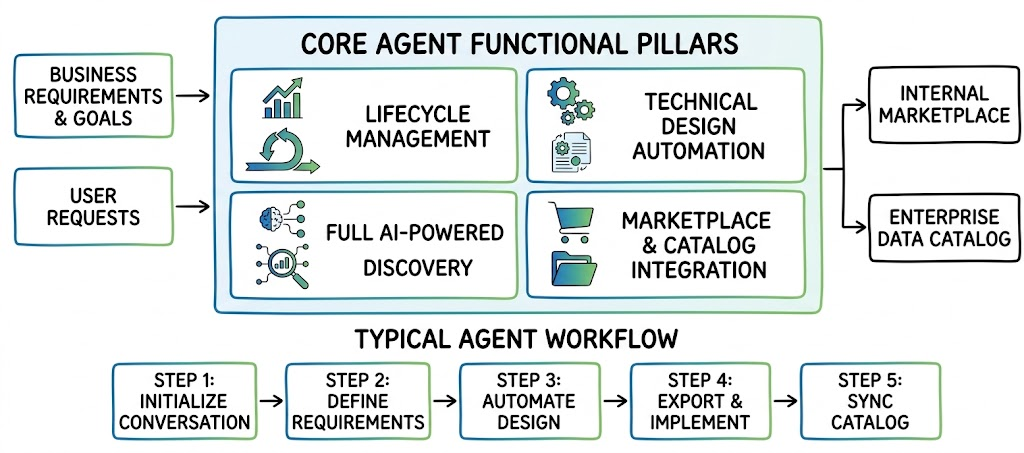
In the Datapunkt ecosystem, specialized agents operate under a Root Orchestrator to automate and govern the entire data pipeline. The Data Product Agent acts as the governance and productization authority, defining the boundary agreements (schemas, access rules, SLAs, and catalog records) that ensure data assets meet enterprise-grade product standards.
The Agent Cooperation Pipeline
The sequence below outlines how the Data Product Agent collaborates with other specialized agents to build and verify a data product:
Source Catalog Agent: Scans raw database tables and APIs, profiling the source data, identifying data types, and publishing raw schemas to the shared metadata catalog.
Data Architect Agent: Establishes the global enterprise architecture (e.g., Medallion, Lakehouse, or Data Mesh) and generates the infrastructure foundation. The Data Product Agent reviews this global architecture to ensure that the proposed data product aligns with enterprise architectural rules and deploys onto approved cloud environments.
Data Modeling Agent: Receives the target requirements and physical schemas, designing optimized tables, Hub-Link-Satellite Data Vault structures, or relational consumption models. The Data Product Agent wraps these schemas into a formalized data product interface, adding SLAs, addressability, and security classifications.
Mapping Contract Agent: Compares source schemas (from the Source Catalog Agent) and target schemas (from the Data Product boundary) to define the column-level transformation rules and business logic in a version-controlled YAML contract.
Transformation Agent: Reads the generated mapping contracts and writes the physical ETL/ELT pipelines using SQL, dbt, or PySpark scripts to populate the target tables.
Data Quality Agent: Ingests the trustworthiness specifications (SLAs/SLOs and test parameters) designed by the Data Product Agent and continuously monitors the physical tables produced by the Transformation Agent to alert on failures.
Synthetic Data Agent: Inspects the data product's schema, identifies PII tags configured by the Data Product Agent, and generates high-fidelity, privacy-preserving synthetic datasets so development and test teams can write applications against the product without viewing sensitive data.
Data Engineer Support Agent: Generates and deploys the Terraform modules needed to host the storage endpoints, setup database connection gateways, and provision access groups defined in the Data Product's addressability configuration.
Data Lineage Agent: Connects the end-to-end lineage graph, mapping where the data product gets its inputs and showing which downstream reports or dashboards consume its columns.
How Collaboration Works in Practice
When a team wants to publish a new governed data product, the collaborative sequence executes automatically:
- The Source Catalog Agent profiles the source databases, identifying structures and potential PII columns.
- The Data Product Agent references these profiles to design the target product boundary. It structures the YAML descriptor detailing how the product is accessed, who owns it, what security controls apply, and what quality thresholds must be met.
- The Data Modeling Agent and Mapping Contract Agent translate this design into database-specific physical schemas and transformation contracts.
- The Transformation Agent executes the pipelines to populate the database tables.
- The Data Quality Agent continuously runs validations to verify the tables meet the trustworthiness rules defined by the Data Product Agent.
- The Synthetic Data Agent builds mock test data based on the schema, and the Data Lineage Agent tracks the data flow from source ingestion to consumption.
This multi-agent coordination ensures that no data asset is published to the enterprise without proper documentation, security controls, and quality validation.
Platform & Tool Integrations
The Data Product Agent supports a wide variety of cloud providers, query engines, open formats, metadata catalogs, and team collaboration platforms.
Cloud Data Platforms & Warehouses
- Google Cloud Platform (GCP): The agent designs data products optimized for BigQuery datasets and Google Cloud Storage (GCS). It generates access configurations utilizing BigQuery Authorized Views, Row-Level Security, and Column-Level Policy Tags.
- Amazon Web Services (AWS): It supports S3 bucket storage architectures and Redshift schemas. The agent configures access interfaces using AWS Lake Formation permissions and IAM policies.
- Snowflake: The agent generates Snowflake-specific secure shares, row-access policies, and dynamic masking rules to make data products consumable across different Snowflake accounts.
- Databricks / Delta Lake: It interfaces with the Unity Catalog to define schemas, tables, and volume mounts, using Delta Lake table formats to support bitemporal query history and ACID transactions.
Open Storage Formats
To prevent vendor lock-in and ensure interoperability, the agent structures data products using open-source table formats:
- Apache Iceberg: Generates metadata specifications and partitioning rules for Iceberg catalogs.
- Delta Lake: Creates schema definitions and transaction log configurations.
- Apache Parquet: Designs optimal columnar chunk layouts and file sizes.
Metadata Catalogs & Governance Platforms
To make your data products discoverable, the agent integrates with popular metadata management tools:
- Collibra & Alation: The agent generates metadata descriptors that can be imported to register the data product in your business glossary and search registry.
- AWS Glue Data Catalog & Unity Catalog: It outputs sync scripts that register table schemas and partition info directly in cloud catalogs.
Team Collaboration & Project Management
- Slack & Microsoft Teams: Teams can connect the agent to DevOps channels. When a data product's schema is updated or an SLA drift occurs, the agent publishes structured notifications to the channel.
- Jira & Confluence: The agent formats generated Technical Design Documents (TDD) into markdown layouts that can be posted directly to Confluence pages or attached to Jira issues.
Security, Privacy, and Data Protection
Data products contain valuable business intelligence and sensitive records. The Data Product Agent is built with a security-first design to protect your enterprise assets.
Zero-Data Storage Policy
The agent does not access or store your actual business data:
- The agent only inspects schemas, column names, technical documentation, business rules, and security classifications.
- It never runs queries on your physical databases to fetch data rows, and it never stores customer records or financial metrics on Datapunkt servers.
Transient In-Memory Processing
All parsing of schema files, compilation of design docs, and generation of YAML product descriptors execute in volatile RAM:
- Once your session is closed, the in-memory cache is immediately purged.
- No design files, schema layouts, or structural metadata are retained on Datapunkt platforms after session termination.
Transit Encryption & Credential Isolation
- TLS 1.3 Encryption: All communication between the workspace, cloud endpoints, and the agent is encrypted in transit.
- Read-Only & Interactive Design: The agent does not require write credentials to your cloud infrastructure. It outputs Terraform scripts, SQL commands, and YAML configs for your engineering teams to review and deploy manually, keeping your database credentials isolated.
Multi-Region Residency Controls
To comply with local regulations (such as GDPR in Europe), you can select where your metadata processing occurs:
- United States (US): Processed in US-based secure memory.
- Europe (EU): Processed in EU-based data centers to satisfy European data privacy guidelines.
- Asia-Pacific (APAC): Processed in APAC data centers.
Troubleshooting & Support
Follow these guidelines to handle common configuration and runtime challenges.
Catalog Registry Sync Failures
If the generated catalog descriptor fails to register in your enterprise search platform (e.g., Alation, Collibra):
- Check that the API token or credentials used by your sync script have sufficient write permissions in the catalog platform.
- Verify that the URN format of the data product matches the naming standard configured in your central catalog metadata schema.
- Paste the catalog API error response into the agent chat pane for troubleshooting assistance and corrected descriptors.
Downstream Schema Drift Exceptions
When upstream tables change their column structures, it can break the data product's schema contract:
- Access the Data Product Agent session and provide the updated upstream schema DDL.
- The agent will compare the new schemas to the existing product contract and highlight breaking changes.
- Ask the agent to generate an updated version (e.g., bumping the semantic version from 2.1.0 to 2.2.0 or 3.0.0) with backward-compatible views.
SLA & SLO Tracking Failures
If the Data Quality Agent reports that your product is violating its delivery freshness SLA:
- Verify that your transformation workflows (e.g., Airflow DAGs, dbt schedules) are executing on time.
- Ask the agent to check the volume statistics of incoming streams to see if data growth has overloaded your query engine.
- The agent can suggest query optimization configurations or partition adjustments to speed up processing.
Technical Support
For custom API configurations, enterprise licensing, or on-premise private deployment options, contact our support team directly via the Datapunkt site.
Benefits: What Makes It Good?
- Secure Sandbox Processing: Your actual data never leaves your infrastructure, and metadata is processed strictly in volatile memory.
- Seamless Tool Compatibility: Works out-of-the-box with GCP, AWS, Snowflake, Databricks, Delta Lake, Apache Iceberg, Unity Catalog, Collibra, and Alation.
- Self-Healing Design: Simplifies resolving schema drift and SLA errors by generating corrected schemas and query optimizations dynamically.
- Multi-Agent Alignment: Ensures the output of your modeling, mapping, transforming, and quality agents comply with a unified, secure data product specification.