
Data Modeling Agent: Use Cases & Domain Standards
Data modeling at scale requires aligning disparate technical schemas with standardized business concepts. The Data Modeling Agent uses semantic mapping and knowledge graph techniques to align raw structures with enterprise taxonomies and regulatory models. This guide covers how the agent supports business use cases and implements major domain standards.
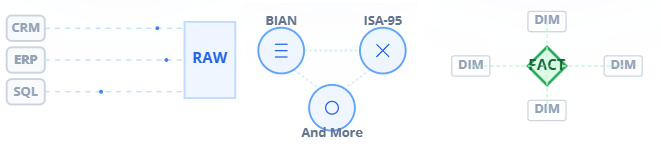
Supported Domain Standards
The Data Modeling Agent features built-in domain expertise to translate and align raw database inputs with leading global standards:
- BIAN (Banking Industry Architecture Network): Defines complex, nested financial services structures, service domains, and control records. The agent represents BIAN as a logical graph, mapping raw transactions to canonical banking concepts.
- ACORD Info: The standard model for the insurance industry. The agent standardizes policy, claim, and client definitions across legacy databases and files.
- ARTS (OMG): The Association for Retail Technology Standards. The agent maps retail customer profiles, transaction logs, and inventory data to unified schemas.
- OMOP CDM (Observational Medical Outcomes Partnership Common Data Model): The primary healthcare model. The agent maps medical records, drug identifiers, and patient events into standard tables for clinical research.
- ISA-95: The international standard for integrating enterprise and control systems in manufacturing. The agent structures equipment hierarchy, material resources, and production schedules.
- TM Forum SID (Shared Information/Data Model): The reference framework for the telecommunications sector. The agent maps subscriber agreements, usage metrics, and billing models.
- IEC 61970: The Common Information Model (CIM) for power systems management. The agent translates physical grid configurations, generation structures, and distribution models into queryable databases.
Core Enterprise Use Cases
The agent helps organizations standardize, query, and govern their data definitions.
1. Semantic Schema Normalization
Organizations ingest data from diverse platforms like relational databases, streaming queues, and cloud files. The agent maps these inputs to standard definitions:
- Banking Systems: Resolves varied customer IDs from legacy databases into a BIAN-compliant "Business Partner" schema.
- Healthcare Systems: Automatically restructures regional EMR records into the unified OMOP CDM layout.
- Telecommunications: Standardizes customer usage data from legacy networks into TM Forum SID-compliant logs.
2. Resolving Entity and Naming Conflicts
The agent evaluates schemas to find equivalent entities using semantic analysis. For instance, it identifies that cust_acc_no (JDBC), ClientNo (Kafka payload), and accountNum (Avro schema) all point to the same logical concept. It unifies them under a standard identifier, allowing downstream systems to join the datasets without manual discovery.
3. Preventing Semantic Drift
Semantic drift happens when business units define fields differently (e.g., Marketing defining a "lead" by signup date, while Finance defines it by payment validation). The agent resolves this by matching schema tables against documented dictionary rules, warning of inconsistencies, and attaching explicit business definitions to technical columns.
Implementing Domain Standards Step-by-Step
The agent enforces these standards through an automated, graph-based alignment workflow:
Step 1: Standard Ingestion & Graph Initialization
The agent loads the desired standard (such as BIAN or OMOP CDM) as a semantic reference graph. Nodes represent standard entities and fields, while edges define relationships and validation rules.
Step 2: Source Schema Parsing & Profiling
The agent scans the customer's schema (databases, files, or messages) to extract column names, data types, nullability, and primary keys.
Step 3: Semantic Alignment Mapping
The agent runs semantic matchers over the parsed schemas. It evaluates column names and data distributions, comparing them to standard concepts in the reference graph. For example, if it finds a column with 9-digit values that look like social security numbers, it maps it to the standard identity field.
Step 4: Schema Transformation Code Generation
Once mapped, the agent generates standard-compliant DDL statements or dbt transformations. This transforms raw staging data into target models without manual code development.
Step 5: Review & Metadata Cataloging
The mapping is registered in the metadata catalog for verification, allowing you to trace each physical field back to its standard definition.
Benefits: What Makes It Good?
- Accelerated Compliance and Industry Alignment: Aligning data with frameworks like BIAN or OMOP CDM manually takes months of architect review. The agent uses graph models to automate this mapping.
- Consistent Cross-System Analytics: By standardizing definitions, the agent ensures that reports from different systems use the same metrics.
- Reduced Schema Drift Risks: Automated validation checks schema designs against domain glossaries, alerting engineers of potential errors before they deploy code.
- Cross-Industry Flexibility: Whether processing financial, manufacturing, healthcare, or utility data, the agent's multi-standard knowledge base adapts to your organization's domain.