
Transformation Agent: Use Cases & Domain Standards
Enterprise data architectures rely on structural standardization to enable scaling, cross-team collaboration, and automatic testing. The Transformation Agent enforces industry standards and structures across codebases, translating raw mapping rules and business requirements into structured assets. By using standardized designs, you make certain that your pipelines align with global schemas, standard architectures, and organization-wide governance rules.
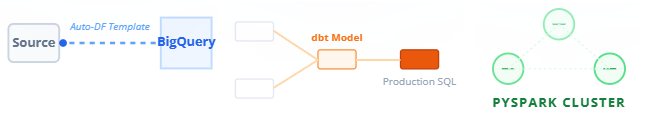
Supported Domain & Metadata Standards
To provide standardized pipelines, the Transformation Agent implements target adapters conforming to major industry architectures and conventions:
SQL Standards Compliance (ISO/IEC 9075)
The agent produces SQL code adhering strictly to target database syntax and ANSI/ISO SQL standards. This ensures compatibility with standard database parsing engines, query optimizer rules, and linters (such as SQLFluff).
Standardized dbt Architecture
The agent structures dbt model code to separate staging layers, intermediate models, and final dimensional layers (marts). This organization keeps downstream datasets easy to navigate and test.
Dataform Assertions and Declarative Configurations
When outputting Dataform models, the agent automatically configures schemas, metadata structures, and assertions (unique keys, non-null requirements, relationships). This guarantees that structural constraints are validated at runtime.
SQLMesh Incremental Loading Conventions
The agent formats SQLMesh files to utilize incremental-by-time-range or incremental-by-partition-range model patterns. This ensures that incremental runs process only modified or new partitions, preventing full table scans and reducing compute costs.
OpenLineage Metadata Facets
To keep lineage tracks accurate, the agent outputs schemas and jobs in formats compliant with OpenLineage run facets. This allows orchestrators (such as Airflow or Dagster) to ingest run structures and map upstream-to-downstream tables automatically.
Spark API Best Practices (DataFrame & SQL)
When generating PySpark pipelines, the agent adheres to standard DataFrame API rules. This includes using schema definitions (StructType/StructField) for ingestion, avoiding loop patterns, and leveraging partition-aware write procedures.
Core Enterprise Use Cases
The Transformation Agent addresses critical engineering, orchestration, and migration scenarios by automating code generation.
1. Legacy Pipeline Migration to Modern Frameworks
Organizations migrating legacy stored procedures, scripts, or old ETL tasks (e.g. from SSIS, Oracle PL/SQL, or old MapReduce) to dbt, SQLMesh, or PySpark face high manual rewrite costs.
- Migration Automation: The agent ingests legacy script files or procedural code, parses the logic, and regenerates equivalent pipelines in the target technology.
- Dialect Translation: The engine converts dialect-specific functions (e.g. Teradata or PL/SQL functions) into standard equivalents in Snowflake Scripting, BigQuery SQL, or PySpark.
- Benefits: Reduces migration project duration from months of manual coding to days of automated conversion and verification.
2. Rapid Prototyping & Business Logic Alignment
Business analysts and product owners frequently document column rules in spreadsheets or requirements documents, requiring data engineers to manually translate them into SQL code.
- Logical Translation: The agent parses mapping spreadsheets and writes optimized join configurations, aggregations, and case-when derivations directly.
- Human-in-the-Loop Refinement: Engineers review generated scripts side-by-side with requirements, instructing the agent to make adjustments interactively.
- Benefits: Shortens the loop between requirement gathering and initial code deployment, ensuring that code matches specifications.
3. Automated Performance Engineering for Enterprise Warehouses
Writing code that works is not enough; queries must be optimized for cloud scale to keep costs under control.
- Target Optimization: The agent detects target platforms (such as BigQuery, Snowflake, or Databricks) and writes optimization constructs. This includes adding cluster keys, configuring window functions, and managing partitioned data.
- Join Engineering: The agent formats joins to prevent data skew, recommending broadcast configurations for small tables when using distributed engines.
- Benefits: Lowers warehouse compute costs out-of-the-box by avoiding expensive full-table scans and redundant query processing.
4. Code Standardization and Boilerplate Generation
Teams frequently struggle with consistent code layouts, testing rules, and documentation formats.
- Enforced Conventions: The agent applies unified conventions, naming rules, folder structures, and automated tests to every generated model.
- Self-Documenting Code: Column descriptions, metadata attributes, and test declarations are written directly into configuration YAML or schema files.
- Benefits: Eliminates manual boilerplate tasks and standardizes style across codebases.
Step-by-Step Implementation Guide for Domain Standards
Follow this operational workflow to generate standardized, compliant pipeline packages:
Step 1: Select Your Target Technology and Conventions
Specify the target tool (such as SQLMesh, Dataform, dbt, or PySpark) and the destination platform (BigQuery, Snowflake, etc.). The agent selects the appropriate compiler rules and syntax targets.
Step 2: Input Logic Requirements and Schemas
Provide the source metadata, schema layouts, and mapping requirements. You can upload files directly or write out business rules.
Step 3: Scaffolding Generation
The agent builds the directory structure, configuration headers, execution code, and accompanying test packages. Review the generated layout in the Right Pane.
Step 4: Validate and Refine Logic
Run sanity checks on the generated code. Use the chat pane to request adjustments to naming rules, column mappings, or testing configurations.
Step 5: Export Standardized Packages
Download the complete code package, including the schemas and YAML configs. Publish the files to your repository to integrate them with your existing pipelines.
Benefits: What Makes It Good?
- Consistent Architectural Patterns: Ensures that all models follow identical scaffolding, naming, and linting rules across your organization.
- Automated Data Quality Gates: Generates companion YAML tests,assertions, and unique constraints alongside the code to detect failures.
- Dialect Portability: Provides the flexibility to translate logic between engines, protecting your codebase from vendor lock-in.
- Cost-Efficient Code Generation: Employs partition-aware and cluster-aware configurations to keep query costs low.