
Data Architect Agent: Use Cases & Domain Standards
Enterprise data architecture is the foundational discipline that determines how an organization stores, moves, governs, and consumes its most critical asset: data. Getting the architecture right accelerates every downstream initiative, from analytics and machine learning to regulatory compliance and real-time operations. Getting it wrong creates years of technical debt, spiraling cloud costs, and organizational bottlenecks that compound with every new data source.
The Data Architect Agent addresses these challenges by acting as an autonomous architectural design engine that generates production-ready blueprints, detailed technical specifications, and deployable infrastructure code across seven industry-proven paradigms.
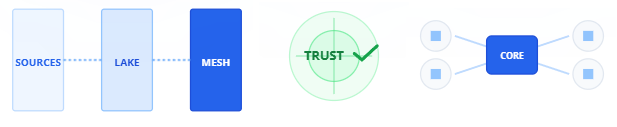
Technical Standards & Capabilities
The Data Architect Agent conforms to rigorous data governance, structural integrity, and enterprise architecture standards by supporting the following key paradigms as first-class design targets.
MEDALLION
The Medallion Architecture is a progressive data refinement pattern that organizes storage into distinct quality tiers. It has become the de facto standard for modern Lakehouse and cloud data platform implementations because of its simplicity, auditability, and clear separation of concerns:
- Bronze (Raw Ingestion): Data lands in its original format with no transformations applied. The agent enforces append-only ingestion patterns, preserves source system schemas exactly as received, defines timestamp-based partitioning for efficient historical queries, and generates retention policies that comply with regulatory requirements. Bronze tables serve as the system of record and the single source of truth for reprocessing.
- Silver (Cleansed & Conformed): Data is deduplicated, type-cast, validated, and conformed to enterprise naming standards. The agent generates deduplication logic using hash-based change detection, defines type coercion rules for cross-system compatibility, applies null-handling strategies, and creates Slowly Changing Dimension (SCD Type 1 and Type 2) merge patterns to maintain historical accuracy while keeping the Silver layer query-efficient.
- Gold (Business-Ready): Data is aggregated, denormalized, and structured for direct consumption by BI tools, dashboards, and machine learning pipelines. The agent designs star schemas, wide tables, or domain-specific data marts with pre-computed metrics, materialized views, and optimized partition and clustering keys for sub-second query performance.
- Inter-Layer Contracts: The agent generates explicit schema contracts between each layer, defining the exact column mappings, transformation rules, and quality checkpoints that must be satisfied before data is promoted from one tier to the next.
SEMANTIC
The Semantic Layer Architecture introduces a governed abstraction between physical data storage and business consumption. It ensures that every stakeholder across the organization works with consistent, trustworthy metric definitions regardless of the underlying query engine or BI platform:
- Metric Catalog: The agent generates formalized metric definitions with explicit calculation logic (e.g.,
revenue = SUM(amount) WHERE status = 'completed'), grain specifications (per day, per merchant, per region), dimension hierarchies (time, geography, product category), and time-intelligence patterns (year-over-year, moving averages, period-to-date comparisons). - Dimension Modeling: Every dimension table includes surrogate keys, natural key mappings, SCD tracking metadata, and hierarchy definitions that enable drill-down analysis from summary to detail levels.
- Business Glossary Integration: Physical column names are mapped to business-friendly labels, descriptions, data steward contacts, data classification tags, and lineage references, ensuring that analysts interact with meaningful terminology rather than cryptic database identifiers.
- Governed Self-Service: The semantic layer enforces role-based access controls at the metric level, restricting visibility to specific measures, dimensions, or row-level data segments based on user groups, departments, or regulatory classifications. This enables true self-service analytics without risking unauthorized data exposure.
- Platform Portability: Semantic definitions generated by the agent are designed to be implemented in dbt Metrics, Looker LookML, Cube.js, or AtScale, ensuring consistency regardless of which BI platform your teams prefer.
DATA VAULT
Data Vault 2.0 is an enterprise modeling methodology specifically designed for environments where auditability, historical tracking, and agile iteration are paramount. It is the preferred pattern for regulated industries (finance, healthcare, insurance, government) where every data change must be traceable to its source:
- Hubs: Represent unique business entities (customers, products, accounts, transactions). The agent generates deterministic hash keys using SHA-256 from the concatenation of business key components, ensuring global uniqueness across federated source systems. Each Hub record includes a load timestamp and record source identifier for full traceability.
- Links: Capture many-to-many relationships between Hubs (e.g., customer-to-account, product-to-order). The agent generates composite hash keys from participating Hub business keys, includes degenerate keys where applicable, and defines hierarchical and same-as Links for complex relationship patterns.
- Satellites: Store temporal attribute data that captures every historical change. The agent generates hash-diff columns for efficient change detection, defines load-end-date patterns for bitemporal tracking, and structures effectivity dating logic for point-in-time reconstruction of any entity's state at any moment in history.
- PIT (Point-in-Time) Tables: Performance acceleration structures that pre-join the latest Satellite records to their parent Hubs, enabling analytical queries to retrieve the current state of an entity without expensive temporal window functions.
- Bridge Tables: Pre-computed link traversal structures that flatten complex multi-hop relationship paths (e.g., customer → account → transaction → merchant) into a single denormalized table for fast reporting queries.
- Reference Tables: Shared lookup tables (currency codes, country codes, status enumerations) that are referenced across multiple Hubs and Satellites without duplication.
DATA MESH
Data Mesh is a decentralized socio-technical architecture where autonomous domain teams own, produce, and serve their data as formal products. The Data Architect Agent generates the organizational structures, governance frameworks, and infrastructure templates needed to implement Data Mesh at enterprise scale:
- Domain Identification & Boundary Design: The agent maps your organizational structure (business units, product lines, functional teams) to logical data domains, each with clearly defined ownership, input sources, and output interfaces. It resolves ambiguous domain overlaps by applying bounded context analysis from domain-driven design principles.
- Data Product Contracts: For each domain, the agent generates a formal data product specification including input ports (source system contracts with schema definitions and freshness guarantees), output ports (published interfaces with versioning, access policies, and discoverability metadata), SLA definitions (freshness, completeness, accuracy, availability targets), and quality rules.
- Federated Governance Framework: The agent produces a global governance overlay that defines mandatory standards (naming conventions, PII handling rules, security classifications, metadata requirements) while respecting domain autonomy. Domains are free to choose their own implementation technologies as long as they comply with the interoperability standards defined in the governance overlay.
- Self-Serve Platform Templates: Modular Terraform templates and infrastructure blueprints that domain teams can instantiate independently to provision their own storage, compute, orchestration, and monitoring infrastructure within guardrails defined by the central platform team.
- Data Product Discoverability: The agent generates catalog registration specifications that enable automated discovery of data products across the organization, including schema registries, API documentation, and quality dashboard integrations.
KAPPA
The Kappa Architecture eliminates batch processing entirely, using a single real-time streaming pipeline as the canonical and only data processing path. It is ideal for organizations where data freshness is measured in seconds rather than hours:
- Immutable Event Log: The agent defines append-only event logs with configurable retention periods, compaction strategies (log compaction vs. time-based retention), and partition key layouts optimized for high-throughput streaming engines. The event log serves as the single source of truth, replacing traditional batch-oriented staging tables.
- Stream Processing Topologies: The agent generates complete processing graph definitions including windowing strategies (tumbling windows for fixed intervals, sliding windows for overlapping periods, session windows for user-activity grouping), watermark configurations for handling late-arriving data, and exactly-once processing guarantees using transactional state stores.
- Materialized Views: Continuously updated queryable views that serve analytical queries directly from the streaming layer. The agent defines view refresh strategies, aggregation granularity levels, and state store configurations (RocksDB, in-memory, or cloud-managed) for optimal read performance.
- Reprocessing & Schema Evolution: When business logic changes or bugs are discovered, the agent designs replay topologies that reprocess the entire event log through an updated pipeline version, producing corrected materialized views without data loss. It also handles schema evolution in event streams using Avro schema registries or Protobuf backward-compatible message definitions.
- Backpressure & Autoscaling: The agent configures consumer group lag monitoring, backpressure handling policies, and auto-scaling rules to ensure the streaming pipeline adapts to traffic spikes without data loss or processing delays.
LAMBDA
The Lambda Architecture maintains parallel batch and real-time processing paths that merge into a unified serving layer. It is designed for organizations that need both real-time responsiveness and guaranteed batch-level accuracy:
- Batch Layer: Scheduled, high-throughput processing pipelines that operate on complete historical datasets. The agent defines batch job schedules, input/output format specifications, incremental processing checkpoints with idempotent write semantics, and fault tolerance configurations that guarantee exactly-once processing over the full dataset.
- Speed Layer: Low-latency streaming pipelines that process individual events as they arrive. The agent generates stream processing definitions with micro-batch intervals, state management configurations, windowed aggregation logic, and delivery guarantees that ensure real-time views are always within seconds of the latest event.
- Serving Layer: The unified query surface where batch and speed outputs are merged. The agent designs the merge logic (batch-wins for historical accuracy, speed-wins for real-time freshness), cache invalidation strategies, query routing configurations, and view materialization schedules that balance freshness against query performance.
- Consistency Reconciliation: The agent generates automated reconciliation jobs that periodically compare batch and speed layer outputs, detect drift, and trigger corrective reprocessing. This ensures long-term consistency between the two processing paths and prevents the serving layer from accumulating stale speed-layer approximations.
- Dual-Path Schema Alignment: The agent ensures that batch and speed layer schemas are structurally compatible, defining shared data contracts that prevent schema divergence as independent teams evolve their processing logic.
LAKEHOUSE
The Lakehouse Architecture unifies data lake storage economics with data warehouse query performance. It eliminates the traditional separation between lakes and warehouses by using open table formats (Delta Lake, Apache Iceberg, Apache Hudi) that provide ACID transactions, schema enforcement, and time-travel capabilities directly on object storage:
- Open Table Formats: The agent generates table definitions with ACID transaction guarantees, time-travel capabilities (query data as of any historical timestamp), and schema evolution support (add columns, rename columns, change types without rewriting data). Each table includes partition pruning specifications, file compaction schedules, Z-ordering configurations for multi-dimensional filtering, and vacuum policies for storage optimization.
- Unified Batch-Streaming Ingestion: The agent designs ingestion pipelines that support both batch file drops and real-time streaming events into the same Lakehouse table. It configures merge-on-read strategies for write-heavy workloads and copy-on-write strategies for read-heavy workloads, selecting the optimal approach based on your access patterns.
- Multi-Engine Query Access: Generated schemas are optimized for direct consumption by Spark SQL, Trino, Presto, Databricks SQL, Snowflake external tables, and BigQuery BigLake, ensuring maximum flexibility across your analytics toolchain without data duplication.
- Storage Lifecycle Management: The agent defines automated file compaction jobs (bin-packing small files), vacuum schedules (purging deleted file references), statistics collection routines (column min/max, null counts, histograms), and tiered storage policies (hot storage for recent data, cold storage for historical archives) to maintain optimal read performance as table sizes grow into petabyte scale.
- Governance & Access Control: Fine-grained column-level and row-level security policies are embedded directly into the table metadata, ensuring that access controls travel with the data regardless of which query engine accesses it.
Core Enterprise Use Cases
The Data Architect Agent addresses several high-value business scenarios that consume the majority of senior architect capacity.
1. Greenfield Enterprise Data Platform Design
Organizations launching new data platforms face months of architectural planning before any data flows.
- The Challenge: A new enterprise data platform requires selecting cloud providers, choosing storage formats, defining processing patterns, establishing governance frameworks, and designing schemas across dozens of business domains. Architectural decisions made at this stage compound for years, and mistakes are extraordinarily expensive to reverse.
- The Agent Solution: Describe your business objectives, expected data volumes, cloud platform preferences, and compliance requirements. The agent selects the optimal combination of architecture patterns (e.g., LAKEHOUSE + MEDALLION + SEMANTIC for a modern analytics platform, or DATA VAULT + LAMBDA for a regulated financial institution), generates a complete HLD with platform selection rationale, produces detailed LLD documents with DDL scripts for every layer, and delivers deployable Terraform Foundation modules.
- The Result: Teams launch production-ready data platforms in days instead of months. Architectural decisions are backed by proven patterns and explicit rationale, eliminating the risk of costly wrong turns.
2. Legacy Data Warehouse Modernization
Migrating from on-premise data warehouses to modern cloud architectures is one of the most complex and risky initiatives in enterprise IT.
- The Challenge: Legacy Teradata, Oracle, or SQL Server warehouses contain decades of business logic embedded in stored procedures, ETL jobs, and reporting layers. Migration requires reverse-engineering existing structures, mapping them to modern patterns, and rebuilding the entire stack without disrupting ongoing business operations.
- The Agent Solution: Provide your existing warehouse DDL scripts, ETL documentation, and business requirements. The agent reverse-engineers the logical data model, maps legacy structures to modern equivalents (e.g., star schemas to DATA VAULT for auditability, or flat tables to MEDALLION layers for progressive refinement), generates target schemas with full DDL scripts, and produces the Terraform infrastructure needed to deploy the new architecture on your chosen cloud platform.
- The Result: Migration timelines shrink from 12-18 months to weeks. The agent produces a complete migration blueprint with source-to-target mappings, transformation rules, and validation checkpoints that ensure zero data loss during the transition.
3. Real-Time Analytics & Streaming Platform Design
Organizations building real-time analytics capabilities need architectures that process events within seconds while maintaining long-term historical accuracy.
- The Challenge: Real-time platforms require fundamentally different architectural patterns than traditional batch systems. Engineers must design event schemas, choose between KAPPA (streaming-only) and LAMBDA (dual-path) architectures, configure stream processing topologies, define materialized view refresh strategies, and ensure exactly-once processing guarantees, all while maintaining compatibility with existing batch-oriented analytics workflows.
- The Agent Solution: The agent evaluates your latency requirements, event volumes, and analytical use cases to recommend the optimal architecture (KAPPA for pure streaming simplicity, LAMBDA for dual-path accuracy, or LAKEHOUSE with streaming ingestion for unified batch-streaming). It generates complete event schema definitions, stream processing topology configurations, materialized view specifications, and the cloud infrastructure needed to run the entire stack.
- The Result: Real-time analytics platforms are designed and deployable within hours. The agent handles the complex trade-offs between latency, throughput, consistency, and cost that typically require deep streaming expertise.
4. Data Mesh Organizational Transformation
Large enterprises adopting Data Mesh need to decompose centralized data platforms into domain-owned data products with federated governance.
- The Challenge: Data Mesh is as much an organizational transformation as a technical one. It requires identifying domain boundaries, defining data product contracts, establishing federated governance standards, and building self-serve infrastructure templates, all while maintaining interoperability and quality standards across autonomous teams.
- The Agent Solution: The agent maps your organizational structure to logical data domains, generates formal data product specifications for each domain (including input/output ports, SLA contracts, quality rules, and governance metadata), produces federated governance frameworks that balance domain autonomy with enterprise standards, and delivers self-serve Terraform templates that domain teams can instantiate independently.
- The Result: Data Mesh adoption accelerates from a multi-year organizational program to a structured, repeatable process. Each domain receives a complete blueprint for building and operating its data products, and the central platform team receives governance frameworks and infrastructure templates to maintain organizational coherence.
5. Regulatory Compliance & Audit Architecture
Regulated industries (finance, healthcare, insurance, government) require data architectures that provide complete auditability, immutable history, and provable compliance.
- The Challenge: Regulatory auditors require proof that every data change is traceable to its source, that historical states can be reconstructed at any point in time, and that data retention and deletion policies are enforced systematically. Traditional star schema designs were not built for this level of auditability.
- The Agent Solution: The agent designs DATA VAULT architectures with complete Hub-Link-Satellite structures that capture every historical change with full provenance metadata. It generates PIT tables for efficient point-in-time queries, Bridge tables for optimized reporting, and governance overlays that enforce retention policies, PII boundaries, and access controls. Terraform modules include automated backup schedules, audit log configurations, and compliance monitoring dashboards.
- The Result: Audit responses that previously took weeks of manual research are answered in minutes using the agent's point-in-time reconstruction capabilities. The architecture provides provable compliance with GDPR, HIPAA, SOX, PCI-DSS, and other regulatory frameworks.
6. Multi-Cloud & Hybrid Architecture Design
Organizations operating across multiple cloud providers or maintaining hybrid on-premise/cloud environments need architectures that ensure portability, interoperability, and consistent governance.
- The Challenge: Multi-cloud architectures must handle different service APIs, storage formats, networking models, and identity management systems across AWS, GCP, Azure, and on-premise infrastructure. Avoiding vendor lock-in while maintaining operational efficiency requires careful architectural planning.
- The Agent Solution: The agent designs cloud-agnostic architectures using open table formats (Iceberg, Delta Lake) and portable processing frameworks (Apache Spark, Apache Beam) that run identically across cloud providers. It generates separate Terraform modules for each cloud provider, unified schema definitions that work across BigQuery, Redshift, Snowflake, and Databricks, and cross-cloud data synchronization patterns that maintain consistency without duplication.
- The Result: Organizations achieve true multi-cloud portability with a single logical architecture that deploys to any cloud provider. The agent eliminates vendor lock-in while maintaining the performance and cost advantages of each platform's native services.
7. Lakehouse Consolidation & Optimization
Organizations with sprawling, organically grown data lakes need to consolidate and optimize their storage into a governed, performant Lakehouse architecture.
- The Challenge: Ungoverned data lakes accumulate thousands of undocumented tables, duplicated datasets, inconsistent schemas, and orphaned files that drive up storage costs and make data discovery impossible. Converting this entropy into a structured LAKEHOUSE requires cataloging existing assets, defining target schemas, establishing governance policies, and migrating data without disrupting active workloads.
- The Agent Solution: The agent analyzes your existing data lake structure, identifies redundant and orphaned datasets, maps valuable assets to target LAKEHOUSE tables with proper MEDALLION layer assignments, generates DDL scripts with ACID-compliant table definitions, and produces Terraform modules for automated file compaction, vacuum scheduling, and tiered storage management.
- The Result: Storage costs drop by 40-60% through elimination of redundant data and automated lifecycle management. Query performance improves dramatically through proper partitioning, clustering, Z-ordering, and statistics collection. Data discovery becomes possible through a governed catalog with business-friendly metadata.
Step-by-Step Configuration Guide
Follow these steps to configure the agent for your specific architectural environment.
Step 1: Define Your Business Context
Describe your organization's industry, primary business objectives, expected data volumes, growth projections, and existing technology stack. The agent uses this context to select appropriate architecture patterns and size infrastructure recommendations accurately.
Step 2: Select Architecture Patterns
Choose one or more architecture patterns from the seven supported paradigms: MEDALLION, SEMANTIC, DATA VAULT, DATA MESH, KAPPA, LAMBDA, and LAKEHOUSE. The agent can combine multiple patterns within a single blueprint. If you are unsure which patterns to use, describe your requirements and the agent will recommend the optimal combination.
Step 3: Establish Compliance & Governance Parameters
Specify your regulatory requirements (GDPR, HIPAA, SOX, PCI-DSS, CCPA), data classification standards, PII handling policies, and retention rules. The agent embeds these requirements directly into the generated schemas, Terraform modules, and governance overlays.
Step 4: Provide Existing Assets (If Applicable)
For migration or modernization scenarios, upload your existing DDL scripts, ETL documentation, data dictionaries, and schema diagrams. The agent reverse-engineers these assets and maps them to the target architecture patterns.
Step 5: Review and Iterate on Generated Designs
The agent generates HLD documents, LLD specifications, DDL scripts, Terraform modules, and data product contracts. Review each artifact in the Right Pane, request modifications to specific components, and iterate until the design meets your requirements.
Step 6: Deploy and Validate
Apply generated Terraform modules to your cloud environment, execute DDL scripts against your target databases, and validate the deployed architecture against the design specifications. The agent can verify that deployed resources match the intended blueprint and flag any configuration drift.
Benefits: What Makes It Good?
- Elimination of Architecture Design Bottlenecks: Automates the most time-consuming, expertise-intensive aspects of enterprise data architecture, freeing senior architects to focus on strategy, stakeholder alignment, and innovation rather than manual schema design and documentation.
- Pattern Expertise on Demand: Provides deep, specialist-level knowledge of all seven architecture patterns (MEDALLION, SEMANTIC, DATA VAULT, DATA MESH, KAPPA, LAMBDA, LAKEHOUSE) without requiring your team to maintain expertise in every paradigm.
- Consistent, Repeatable Designs: Every generated blueprint follows the same rigorous standards for naming conventions, governance integration, security controls, and structural integrity, eliminating the variability that comes from different architects applying different personal preferences.
- Accelerated Time-to-Value: Reduces enterprise architecture design cycles from months to hours, enabling organizations to respond to new business requirements, regulatory changes, and market opportunities at the speed of their competitors.
- Built-In Compliance & Governance: Every generated artifact includes data classification tags, PII boundary definitions, retention policies, access control hierarchies, and audit trail configurations, ensuring that compliance is a built-in property of the architecture rather than an afterthought.
- Seamless Migration Support: Reverse-engineers legacy warehouse structures, maps them to modern patterns, and generates complete source-to-target migration blueprints with validation checkpoints, dramatically reducing the risk and timeline of modernization initiatives.