
Mapping Contract Agent: Use Cases & Domain Standards
Modern enterprise integration demands high-fidelity schema translation that bridges the gap between different technical formats and standardized industry taxonomies. The Mapping Contract Agent automates this alignment by translating physical schemas into standard structures while maintaining strict data governance. This guide details how the agent enforces leading industry domain standards and solves critical integration use cases.
Supported Domain Standards
The Mapping Contract Agent has built-in semantic mappings and structural graphs for the world's most common enterprise domain standards:
- BIAN (Banking Industry Architecture Network): Standardizes banking transactions, customer portfolios, and general ledger accounts. The agent translates legacy relational database schemas into BIAN-compliant canonical messages.
- ACORD Info: The global standard for the insurance industry. The agent maps policy structures, claims, and policyholder details from files and tables into standardized layouts.
- ARTS (OMG): The standard for the retail sector. The agent maps point-of-sale logs, inventory updates, and loyalty database schemas to unified formats.
- OMOP CDM (Observational Medical Outcomes Partnership): The primary healthcare clinical model. The agent maps heterogeneous electronic health record (EHR) schemas to standard medical vocabularies and patients tables.
- ISA-95: The standard for manufacturing systems. The agent structures physical equipment logs, product tracking events, and manufacturing execution metadata.
- TM Forum SID: The telecommunications reference model. The agent maps customer usage records, service activation messages, and billing events to canonical schemas.
- IEC 61970: The Common Information Model (CIM) for utilities. The agent maps electrical grid topologies, smart meter logs, and generation details to relational database tables.
Core Enterprise Use Cases
The Mapping Contract Agent addresses critical real-world integration challenges, utilizing its core features to deliver robust solutions.
1. Mapping Heterogeneous Sources to Industry Standard Models
Organizations must integrate multiple different back-ends (such as legacy SQL databases, raw CSV files, and real-time Kafka streams) into standard architectures like BIAN or OMOP CDM.
- Source to Target Alignment: The agent inspects the source schemas (e.g., table formats, field details) and correlates them to standard destination definitions.
- Business Logic & Code Generation: It compiles the required mapping rules into optimized SQL or Python scripts, allowing developers to immediately run the pipeline.
- Automated Docs: It generates detailed metadata documents that map each physical source field back to the matching industry standard concept.
2. Implementing Robust Quality Control on Inbound Feeds
When importing external datasets, organizations face data errors that can break reporting and analytics engines.
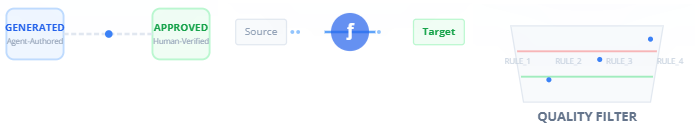
- DQ Validation Gates: The agent embeds rigorous data validation rules (e.g., checking null limits, verifying date formats, and validating numeric ranges) inside the mapping contract.
- Source to Target Protection: The generated SQL/Python transformation code tests the incoming data against these DQ rules, preventing bad data from entering your destination warehouses.
3. Change Auditing and Regulatory Compliance (GDPR, HIPAA, CCPA)
Under global privacy mandates, companies must prove exactly how customer data (like PII) is mapped, transformed, and managed.
- Approval Workflow Verification: The agent ensures that every schema mapping change is formally approved by a human administrator, recording the identity of the approver.
- Version Control Tracking: The agent logs all mapping updates under strict version control. Auditing teams can check prior versions to track modifications to the data pipeline over time.
Step-by-Step Guide to Implementing Domain Standards
Follow this operational flow to map your custom database schema to an industry standard target:
Step 1: Initialize the Reference Model
The agent loads the semantic reference graph for your target standard (such as BIAN or ACORD) to understand the destination columns, types, and constraints.
Step 2: Establish the Source-to-Target Map
Paste or load your source database schema into the chat window. The agent runs semantic matchers to generate a draft mapping between your source fields and the target standard.
Step 3: Define Custom Business Transformations
Add your specific transformations (e.g., calculations, string formats) using plain text prompts. The agent translates these requirements into executable SQL/Python code blocks.
Step 4: Add Data Quality Verification
The agent auto-suggests DQ Validation rules based on the industry standard's requirements. Review and finalize these rules in the workspace editor.
Step 5: Formally Review and Approve
Run the human-in-the-loop Approval Workflow to verify the contract. The agent logs the approvals and registers the metadata in the system.
Step 6: Commit and Deploy via Version Control
Export the final contract and push it to your Git repository. The version-controlled file is then pulled by your CI/CD system to deploy the transformations to your pipelines.
Benefits: What Makes It Good?
- Rapid Standard Compliance: Manually mapping legacy schemas to complex frameworks like BIAN or OMOP CDM can take weeks. The agent automates this design process in minutes.
- Elimination of Schema Drift Risks: The combined use of Version Control and DQ Validation prevents unexpected source system updates from breaking downstream warehouse tables.
- Certified Audit Trails: By logging every modification and requirement within the Approval Workflow, the agent provides instant compliance reporting for regulatory audits.
- Unified Business Logic: Transformation rules are kept in a central contract rather than being scattered across custom scripts, ensuring consistent outputs.