
Data Modeling Agent: Architecture, Integrations, & Security
Enterprise data modeling requires coordination, platform support, and strict security designs. The Data Modeling Agent integrates with other Datapunkt agents, supports multiple destination platforms, and operates within a zero-storage security framework.
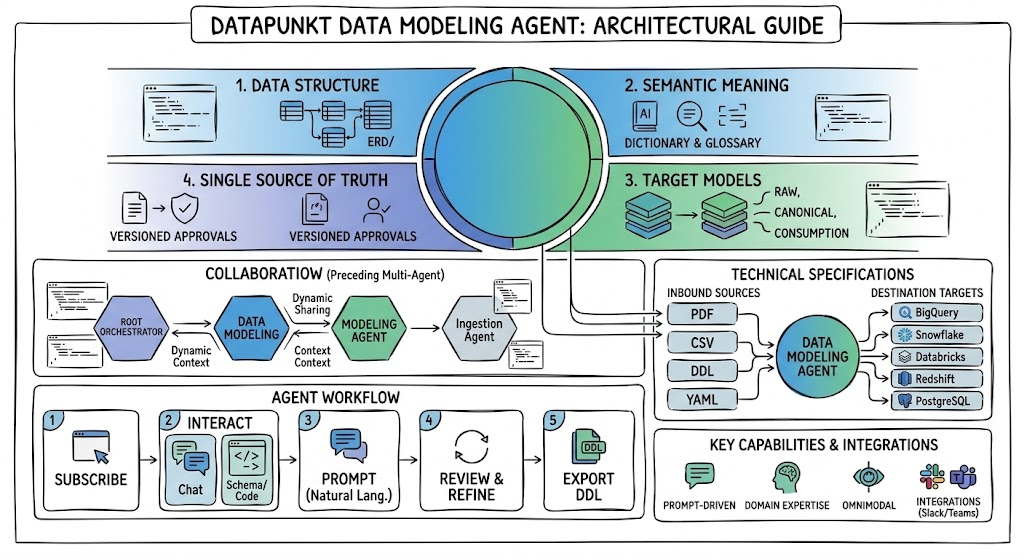
Multi-Agent Architecture & Cooperation
In the Datapunkt system, specialized agents work together under the control of the Root Orchestrator. The Data Modeling Agent acts as the structural and semantic coordinator:
- Source Catalog Agent: Finds raw data sources and publishes schemas. The Data Modeling Agent uses this metadata to map raw data to standardized models.
- Data Lineage Agent: Relies on the Data Modeling Agent's schemas to build column-level and table-level lineage trees.
- Data Quality Agent: Uses the generated models to establish target expectations (such as valid key relationships and null limits) for quality checks.
- Transformation Agent: Uses the physical models and DDL scripts to build ETL/ELT pipelines, converting raw structures to clean, standardized target states.
This collaboration ensures that when the Source Catalog Agent detects a schema change, the Root Orchestrator directs the Data Modeling Agent to evaluate and update the affected schemas.
Integrations
The Data Modeling Agent translates metadata requirements into target models optimized for major data engines.
Supported Inbound Source Formats
- Natural Language Requirements: Text descriptions or business briefs.
- Uploaded Data Dictionaries: CSV and PDF files detailing system attributes.
- Legacy System Artifacts: SQL scripts and Entity-Relationship Diagram documents.
- Schema Specifications: JSON Schema, YAML, and XML files.
Destination Targets and Dialects
- Google BigQuery: Optimizes partitions, clustering layouts, and nested fields.
- Snowflake: Configures models for micro-partitioning, variant columns, and secure shares.
- Amazon Redshift: Optimizes distribution keys and sorting parameters.
- Databricks / Delta Lake: Creates tables optimized for liquid clustering and z-ordering.
- PostgreSQL / Aurora: Generates standard relational SQL scripts.
- SQL Server / Azure Synapse: Builds dedicated SQL pool distributions.
- Generic ANSI SQL: Relational SQL standard for other systems.
Collaborative Chat Integrations
Enterprise users can connect the Data Modeling Agent to Slack or Microsoft Teams:
- Teams can model schemas collaboratively in shared channels.
- Contact the support team on the Datapunkt site to request setup tokens.
Security, Compliance, and Data Residency
The Data Modeling Agent processes metadata inside a secure architecture designed to protect enterprise data assets.
Zero-Storage Architecture
The agent uses a zero-storage model: no customer schemas, table records, or uploaded files are stored on Datapunkt's servers. All analysis is processed in memory and deleted when the session ends. Because your raw data does not leave your network perimeter, exposure risks are minimized.
Enterprise Compliance Support
The agent is designed to support global privacy regulations:
- GDPR & CCPA: Simplifies compliance by identifying where Personally Identifiable Information (PII) is modeled, allowing audits across databases and files.
- SOC 2 & ISO 27001: Operates using credential isolation, encrypted transit, and detailed audit logging.
Multi-Region Residency Controls
You can specify the region where the agent instance and its temporary session metadata reside:
- United States (US)
- Europe (EU)
- Asia-Pacific (APAC)
- Customer-Specified Location (for custom deployments)
Troubleshooting & Support
Below are common practices for managing operational challenges:
Handling Complex or Nested JSON Fields
When processing highly nested inputs (like JSON logs from MongoDB), instruct the agent to flatten these structures into structured SQL views during the curated design step.
Implementing Custom Enterprise Standards
If your organization uses specific naming conventions (such as prefixes like stg_ or v_), define these guidelines at the start of your chat session, and the agent will apply them to all generated schemas.
Requesting Support
For billing, custom API licenses, or subscription assistance, contact our support team through the Datapunkt site.
Benefits: What Makes It Good?
- Optimized Destination Performance: The agent designs schemas tailored to each database's strengths (such as Snowflake partitioning or BigQuery clustering), reducing query costs.
- Metadata-Only Security Boundaries: The agent operates on metadata and structure rather than your sensitive underlying transaction files.
- Shared Workspace Collaboration: Slack and Teams integrations allow developers and architects to build models together, improving team alignment.
- Multi-Agent Coordination: Autonomous coordination prevents manual errors and reduces the work needed to build enterprise data pipelines.