
Data Product Agent: Use Cases & Domain Standards
Enterprise data management often suffers from the "data swamp" problem, where files and database tables accumulate without clear ownership, documentation, or quality standards. To resolve this, modern data architectures employ the Data Mesh paradigm, treating data as a product.
The Data Product Agent enforces this paradigm across your organization. It ensures that every data asset generated is treated as a first-class product, maintaining clear governance, high trustworthiness, and seamless integration with corporate business values.
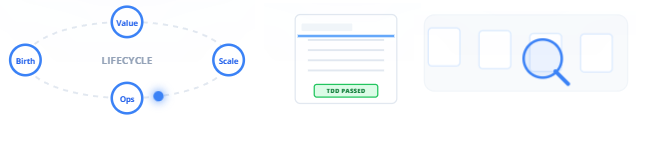
Implementation of Core Domain Standards
The Data Product Agent translates the theoretical qualities of a data product into concrete, enforceable technical standards. Below is how the agent structures each of the seven core principles:
Secure
Data security cannot be an afterthought managed solely by infrastructure firewalls. The agent implements security directly at the data product boundary:
- PII Classification: The agent scans incoming column definitions and automatically identifies potential Personally Identifiable Information (PII) like emails, addresses, names, and credit cards, applying appropriate security tags.
- Role-Based Access Policy: It generates standard access rules (e.g., Row-Level Security, Column-Level Masking) that travel with the data product, ensuring that regardless of the engine used to query it (e.g., Snowflake, BigQuery, Spark), the security policies are applied.
- Data Sovereignty Compliance: The agent structures data residency rules to keep data stored in specified regions (e.g., EU-only for GDPR compliance) while allowing metadata-level discovery globally.
Interoperable
For data products to deliver value, they must be easily combined across domains (e.g., joining sales data with marketing data):
- Standardized Formats: The agent designs tables using open formats such as Apache Iceberg, Delta Lake, or Parquet, eliminating proprietary database locks.
- Common Semantic Types: It maps custom fields to shared organizational schemas (such as ISO country codes or UTC timestamps), ensuring that data products from different teams can be joined without manual formatting.
- Cross-Domain Join Keys: The agent flags key fields (like standardized customer IDs) and ensures they use identical hashing or encoding methods across different data products.
Addressable
A data product must have a stable, reachable address so consumers can access it without asking the owner for connection parameters:
- Stable URIs: The agent designs immutable addresses (such as S3 bucket paths, Google Cloud Storage URIs, or database schema paths) that remain persistent even when underlying infrastructure scales or migrates.
- Multi-Protocol Gateways: It creates specifications for accessing data via standard query engines (Trino, Snowflake, Spark) and APIs, documenting connection parameters within the product descriptor.
Discoverable
If a data product cannot be found, it does not exist:
- Automated Catalog Sync: The agent formats product details so they can be read by enterprise metadata platforms (like Collibra, Alation, Apache Atlas, or custom internal catalogs).
- Rich Search Tagging: It generates logical tagging profiles, classification tags, search terms, and functional keywords based on the data product's contents.
Understandable
Data products must have clear context so consumers know how to interpret them without scheduling meetings with the data engineers:
- Auto-Generated TDDs: The agent writes comprehensive Technical Design Documents explaining the purpose, scope, and update frequency of the product.
- Business Glossary Mapping: It translates technical database column names into human-readable definitions (e.g., mapping
mrr_valto "Monthly Recurring Revenue"). - Upstream & Downstream Lineage: The agent details exactly which source systems feed the product and which dashboards consume it.
Self-Describing
Consumers should be able to query the data product and understand its contents programmatically:
- Embedded Schemas: The product contains its own schema definitions, column types, and descriptions, allowing query tools to inspect the metadata directly.
- Schema Evolution Log: It embeds logs showing how the schema has evolved over time, tracking additions or deprecations of columns.
- Freshness & Version Indicators: The product displays its latest update timestamp and schema version identifier directly in the metadata.
Trustworthy
Consumers must be confident that the data is accurate, complete, and fresh:
- Automated Quality Checks: The agent designs and enforces test parameters (like null checks, type enforcement, value distribution checks) that run on every pipeline execution.
- SLAs and SLOs: It formalizes Service Level Agreements (SLAs) for data delivery times and Service Level Objectives (SLOs) for data quality metrics, exposing these metrics to the consumer.
Core Enterprise Use Cases
The Data Product Agent is deployed across several critical enterprise scenarios to accelerate development and guarantee data quality.
1. Greenfield Data Product Design
When launching a new analytical initiative, teams face weeks of design meetings. The agent simplifies this:
- The Challenge: Designing a new, clean data product requires defining schemas, security rules, access points, and quality parameters from scratch.
- The Agent Solution: Provide the agent with the high-level business goals and source data types. The agent automatically creates a complete, compliant Data Product blueprint including schema layouts, PII designations, and access structures in minutes.
- The Result: Projects launch weeks faster with all security, interoperability, and quality gates pre-configured.
2. Legacy Pipeline Modernization
Many enterprises have undocumented legacy pipelines feeding critical business decisions:
- The Challenge: Legacy database schemas lack clear ownership, have bad naming standards, and are missing security rules and documentation.
- The Agent Solution: Upload legacy database DDLs and ETL scripts. The Data Product Agent reverse-engineers the structures and formats them into a clean, modern Data Product model complete with standardized columns, documentation, and security tags.
- The Result: Legacy data is cleaned, documented, and exposed as a modern product without disrupting active business queries.
3. Automated Catalog Registry & Discovery
Keeping enterprise data catalogs updated is a manual bottleneck:
- The Challenge: As data engineers build new pipelines, they forget to update central search engines and data catalogs, leading to discoverability gaps.
- The Agent Solution: The agent generates catalog descriptor files on every deployment, automatically registering the new data product in platforms like Alation, Collibra, or AWS Glue Data Catalog.
- The Result: Search catalogs are updated instantly without manual data-steward intervention.
4. Value Engineering & Strategic ROI Alignment
Organizations frequently build datasets that deliver no business value, driving up cloud costs:
- The Challenge: Tech teams build pipelines based on requests, but there is no tracking of which datasets feed which business objectives.
- The Agent Solution: The agent prompts users to declare target consumer personas, KPIs (e.g., customer retention), and ROI metrics. It maps these goals directly to the columns and schemas of the data product.
- The Result: Wasteful data pipelines are eliminated, and engineers can justify infrastructure costs by pointing to the business value mapped within the product.
5. Test-Driven Data Product Development
Broken pipelines often pollute downstream reports, leading to incorrect business decisions:
- The Challenge: Data quality tests are usually written after pipelines are deployed, or are omitted entirely due to time constraints.
- The Agent Solution: The agent enforces a Test-Driven Development (TDD) model, generating data quality test suites (like schema compliance checks, validation regexes, and volume constraints) before any code is deployed.
- The Result: Bad data is stopped before it enters production, maintaining high trust in business reports.
Step-by-Step Configuration Guide
Follow this guide to define and configure your data product principles using the agent:
Step 1: Set Business Goals and ROI
Define the purpose of the data product, who will use it, and what business KPIs it supports. State these goals clearly in the session chat to establish strategic alignment.
Step 2: Ingest the Source Schemas
Provide the source database tables, files, or API payloads. The agent will read these schemas and map them to standard data types.
Step 3: Configure Security & PII Rules
Specify which columns contain sensitive data. The agent will tag these columns with security flags and design appropriate masking rules.
Step 4: Establish SLAs and SLOs
Define data freshness expectations (e.g., daily refresh, real-time sync) and quality thresholds (e.g., less than 0.1% null values). The agent embeds these rules into the quality test configurations.
Step 5: Validate and Refine the Descriptor
Review the generated YAML product descriptor. Verify that access endpoints, column definitions, and security policies are correct, requesting adjustments in plain language until the spec is perfect.
Step 6: Generate the Deployment Package
Command the agent to export the bundle. Use this bundle to build your infrastructure and register the product in your enterprise catalog.
Benefits: What Makes It Good?
- Frictionless Data Sharing: Standardizing schemas and naming conventions across products allows different teams to join datasets without complex ETL mappings.
- Clear Ownership: Every data product has a defined domain owner and SLA, ensuring that operational failures are routed to the right team immediately.
- Robust Compliance Audits: With built-in security classification, access rules, and lineage documentation, responding to regulatory audits becomes straightforward.
- Reduced Cloud Costs: Aligning data products with actual business value helps organizations identify and decommission unused, expensive datasets.