
Legalpunkt: The Autonomous Legal Agentic System
Meet the Legal Agentic System
LegalPunkt is an advanced AI-powered legal ecosystem built specifically to navigate the highly complex, fast-moving landscape of the law, complete with robust global integrations.
At its heart we have a Legal Agentic System—a multi-lingual, AI-powered autonomous environment built specifically for the demands of modern jurists. At its core, Legalpunkt serves as your ultimate digital partner, transforming how you handle legal documentation, automate routine tasks, and interrogate global jurisdictions.
Whether you are auditing complex commercial contracts against local corporate playbooks, running semantic searches across international court registries, or orchestrating multi-step deep research loops, Legalpunkt coordinates every action through a suite of dynamic controls and specialized skills. It is an ecosystem powered by native integrations, allowing your AI co-counsel to act as part of your firm’s existing workflow, rather than alongside it.
To achieve this level of capability without compromising accuracy, Legalpunkt is structured like a modern agentic system—built layer by layer from a model-independent foundation up to purpose-built, secure-by-design user interfaces.
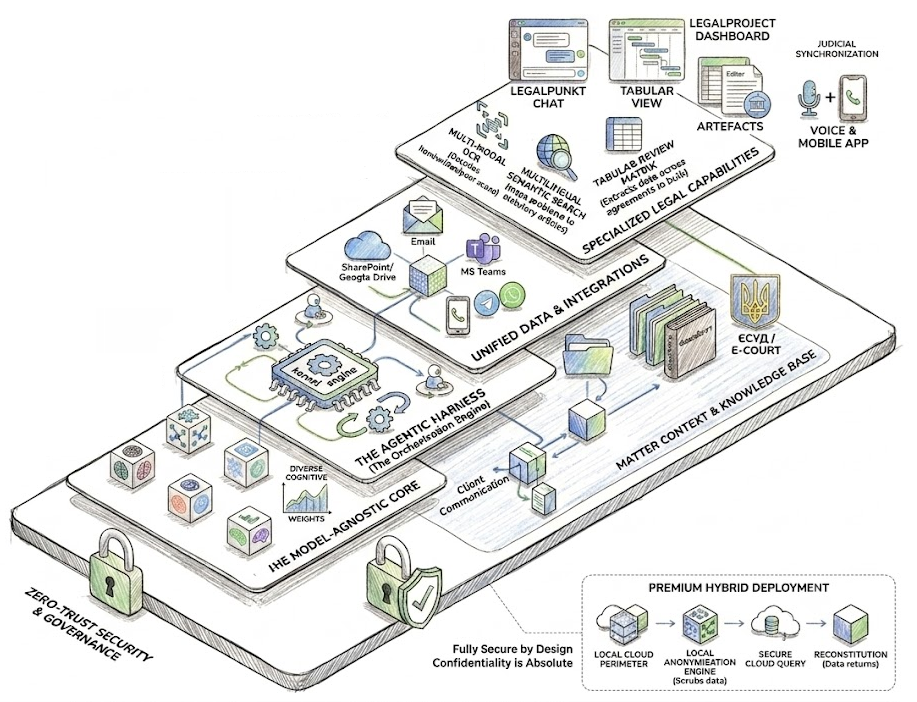
Inside the Legal Agentic System: A Layer-by-Layer Breakdown
1. The Model-Agnostic Core
At its foundation, Legalpunkt is entirely model-independent. Because legal tasks vary in complexity—from drafting a short email to conducting a multi-jurisdictional risk assessment—Legalpunkt gives you an option to manually choose the optimal AI model before submitting each prompt or message. As underlying AI models advance, the platform integrates these improvements seamlessly without requiring structural changes to your workflow.
- User-Driven Model Selection: You choose the model that fits your specific task—selecting fast, efficient models for quick clause extractions, or deeper reasoning engines for complex legal analysis.
- Specialized Reasoning Models: Select purpose-built reasoning models tailored for challenging legal tasks, such as tracing historical statutory amendments, parsing dense case histories, or synthesizing jurisdictional conflicts.
- Continuous Adaptation: As you add matter documents, configure playbooks, and provide project instructions, the system refines its context and aligns with your firm's specific standards and terminology over time.
2. The Agentic Harness (The Orchestration Engine)
General-purpose language models are necessary for natural language processing, but they are fundamentally insufficient for legal work. Without guardrails, they lack procedural awareness and can hallucinate. The Agentic Harness is our proprietary orchestration engine—the "kernel" of the legal agentic system—that turns general-purpose LLMs into highly specialized, autonomous legal agents. This harness manages iterative execution loops, enforces strict verification of claims, and drives agents to execute multi-step research or document audits autonomously until they reach a verified result.
- The Co-Counsel Engine: At the center of the harness sits the Legal Agentic System—a unified reasoning engine that coordinates all workspace tools, reads and indexes matter context, and dynamically scales its operations across the full spectrum of legal tasks. It retains persistent memory across all tabs of your active project, ensuring you never have to repeat background details or risk context loss.
- Multiple Operation Modes: The harness supports several execution modes depending on the scope of your inquiry—Standard Interaction for day-to-day drafting and Q&A, Deep Legal Thinking (powered by Gemini 3.1 Deep Think) for deliberate multi-stage legal reasoning and hypothesis stress-testing, and Multi-Modal Analysis & OCR for reconstructing low-quality scanned documents and handwritten court papers.
- Investigative & Reasoning Depth: Where a standard query might return a general overview, the Deep Legal Thinking engine pursues questions to their logical conclusion—dissecting statutory provisions, evaluating adversarial arguments, cross-referencing historical precedents, and reconciling conflicting positions before presenting structured, citation-backed deliverables.
- Contextual Guardrails: The harness ensures the agent does not hallucinate or draw from generic web data unless explicitly instructed. It answers queries based strictly on the context of the files, playbooks, and systems connected to your active project, eliminating the risk of factual errors.
3. Unified Data & Integrations
For a legal agentic system to be effective, it cannot sit in isolation. Legalpunkt operates as an organic part of the firm's existing ecosystem, not alongside it. Through native integrations, the system bridges the gap between your active workspace and the external world. It connects directly with Document Management Systems, daily communication tools, and official judicial databases. Information flows automatically from client communication straight into your secure project context.
- Document Management Connectors: Native integrations with Google Drive, SharePoint, and OneDrive allow the agent to read, index, and reference documents from your existing repositories—without requiring manual uploads or data migration. Once connected in Settings, integrations are available across all your projects.
- Communication Channels: Integrations with email, Microsoft Teams, Telegram, and WhatsApp enable the agent to receive instructions, share deliverables, and surface case updates through the channels your team is already monitoring.
- Judicial Registries: Direct, real-time connections to official court databases—including Ukraine's Єсуд (E-Court), UK Case Law via The National Archives and BAILII, US Federal and State court records via CourtListener/RECAP, and EUR-Lex for the European Union—ensure the agent always works with authoritative, up-to-date legal data.
- Dynamic Source Selection: During any chat session, you can dynamically activate or combine search sources—LegalSearch, Deep Search, Web Search, Project Search, and Deep Legal Thinking—on a per-query basis, instructing the agent to cross-reference uploaded contracts against live court precedent in a single interaction. For full configuration details, see the Interoperability & Configuration guide.
4. Matter Context & Knowledge Base
A law firm's most valuable asset is its collective intelligence—historical precedents, custom clause libraries, corporate risk playbooks, and case history. Legalpunkt injects this institutional memory directly into every agent interaction. When you ask Legalpunkt to review a document, it doesn't draw from generic templates; it references your firm's specific historical standards, preferred drafting guidelines, and specific client matter history. Lawyers get the collective, accumulated experience of the entire firm layered into every single recommendation.
- The Context Tab: Every project workspace includes a dedicated Context repository that transforms raw documents—contracts, briefs, regulatory filings, corporate resolutions, and witness transcripts—into an active, searchable knowledge base. Files can be ingested from local uploads, Google Drive, SharePoint, or directly synchronized from judicial registries like Єсуд.
- Intelligent Document Indexing: Uploaded documents pass through a robust pipeline: Optical Character Recognition (OCR) converts legacy contracts and scanned PDFs into machine-readable text; layout and structural parsing preserves hierarchical formatting, footnotes, tables, and signature blocks; semantic mapping and vectorization records underlying legal concepts rather than rigid keywords; and entity and definition extraction automatically indexes key terms, governing laws, party names, and critical dates.
- Custom Playbooks: Playbooks encode your firm's specific contractual policies, risk tolerances, and clause preferences into structured rulesets. Multiple playbooks can be active simultaneously—for example, running a general corporate governance playbook alongside a client-specific risk tolerance playbook—and the agent will reconcile both during its review.
- Fully Indexed Intelligence: Once a document transitions to Indexed status, it becomes part of the project's active intelligence. You can draft motions, construct comparative analysis tables, or conduct risk reviews with the assurance that the AI is reference-checking its answers against every relevant page in the workspace.
5. Specialized Legal Capabilities
This is the domain intelligence layer where raw computing becomes practical legal mastery. Legalpunkt features a suite of modular, specialized legal capabilities. This includes our high-fidelity, layout-aware multi-modal OCR that decodes handwritten or poorly scanned court documents, a multilingual semantic search engine that maps everyday business problems to formal statutory articles, and an empty-state-first tabular review matrix for extracting data across hundreds of agreements in bulk. These capabilities represent the modular tools jurists can deploy to solve complex, high-stakes problems.
- Modular Skills Marketplace: Skills are domain-specific capability packs that extend the agent's core reasoning engine. The marketplace includes Commercial Contract Review, NDA Review, Privacy Notice Generator, Privacy Compliance Navigator, Legal Risk Assessment Matrix, Transcript & Quote Analysis, Legal Invoice Auditor, and Legal Timesheet & Invoice Generator—each encapsulating structured review parameters, jurisdiction-specific statutes, and automated extraction workflows.
- LegalSearch — Semantic Legal Discovery: LegalSearch is a multilingual semantic search engine that translates everyday business language into core legal concepts, searching across millions of court rulings, legislative acts, and precedents globally. It features advanced filtering across seven parameters—including jurisdiction, instance, category, case type, and date—to narrow results with precision. Every result includes a precise semantic match percentage for immediate authority assessment.
- The Precedent Bridge: When you locate a vital court decision in LegalSearch, one click on "Analyse in LegalPunkt" feeds the entire judgment into your active project's chat agent for comprehensive legal analysis—no copy-pasting or context-switching required.
- Tabular View — Bulk Data Comparison: The Tabular View provides a highly customizable spreadsheet matrix allowing you to compare multiple massive contracts at once and extract all needed, necessary, and required info. It features workbook templates (Due Diligence Audit, NDA Review, Commercial Lease Audit), dynamic column customization with AI-generated extraction prompts, a three-panel split review layout with confidence scores and human-in-the-loop controls, and project-level collaboration with CSV/Excel export.
- Multi-Modal OCR & Vision Pipeline: The system's layout-aware multi-modal vision pipeline automatically reconstructs low-quality scanned documents, PDF filings, and photographs of court papers—extracting text from handwritten notes and low-contrast images and integrating them directly into the active workspace context.
6. Zero-Trust Security & Governance
This is the foundation that makes the legal agentic system enterprise-ready. In legal practice, confidentiality is absolute. Legalpunkt was engineered from the very beginning to be truly reliable, and fully secure by design. Security is not bolted on; it is built into every single layer of the platform. We offer Managed Multi-Tenant SaaS, Dedicated Single-Tenant Cloud instances, and On-Premises VPC container deployments. Underpinned by zero-knowledge parameters, strict matter-to-matter isolation, real-time sync, and detailed audit trails, your data remains yours alone.
- EU Data Residency: All standard multi-tenant SaaS environments are hosted in Germany (AWS EU-Central-1 region, Frankfurt). No client data is stored or processed outside the European Economic Area (EEA) by default. Encrypted snapshots are taken every 24 hours, retained for 30 days, and secured with AES-256 encryption.
- Three Deployment Models: Managed Zero-Trust Multi-Tenant Cloud SaaS for immediate access with logically separated databases; Dedicated Single-Tenant Cloud with a private VPC on AWS or Azure in your preferred geographic region; and On-Premises VPC for deploying protected containers directly within your private network or corporate firewall.
- Zero-Knowledge AI Engine: Once our reasoning model concludes a playbook review, contract parsing, or document generation, all session cache states are purged immediately. No client information or generated legal intelligence is ever retained or ingested for subsequent AI training cycles.
- Enterprise Access Controls: Strict matter-to-matter isolation ensures no cross-contamination between client engagements. Attribute-based access control (ABAC), Adaptive Directory Sync (SCIM), and Single Sign-On (SSO) via Google Workspace, Microsoft Entra ID, Okta, or GitHub guarantee that only authorized users can read, modify, or export sensitive intelligence.
- Security Center & Compliance Audits: The Security Center provides a live transparency portal. Administrators can monitor real-time security compliance controls and request access to key security artifacts—including the Security Whitepaper, Information Security Policy, and network Architecture Diagrams.