
Synthetic Data Agent: Architecture, Integrations, & Security
Modern enterprise data architectures require high security, platform connectivity, and automated agent cooperation. The Synthetic Data Agent is designed to operate seamlessly within a collaborative multi-agent ecosystem, integrate directly with cloud data warehouses and orchestration tools, and run within a strict zero-data-storage security sandbox.
Multi-Agent Architecture & Cooperation
In the Datapunkt ecosystem, specialized agents work together under the Root Orchestrator to design, validate, execute, and monitor data pipelines. The Synthetic Data Agent functions as the primary privacy and test data provisioner, ensuring you have compliant sandbox data without risk.
The Agent Cooperation Pipeline
- Source Catalog Agent: Accesses physical data sources (e.g., PostgreSQL, MySQL), profiles datasets, and publishes schema definitions.
- Data Modeling Agent: Ingests source structures and constructs target schemas (such as Raw Vault or analytical models) optimized for the warehouse.
- Mapping Contract Agent: Compares source schemas with target schemas to define specific transformation rules and data quality constraints in a version-controlled YAML contract.
- Transformation Agent: Reads the generated mapping contracts and executes physical transformations (using SQL or Python scripts).
- Data Quality Agent: Analyzes data schemas, translates natural language rules into active validation logic, and monitors data streams for quality failures across seven key dimensions (INTEGRITY, TIMELINESS, COMPLETENESS, ACCURACY, CONSISTENCY, UNIQUENESS, and VALIDITY).
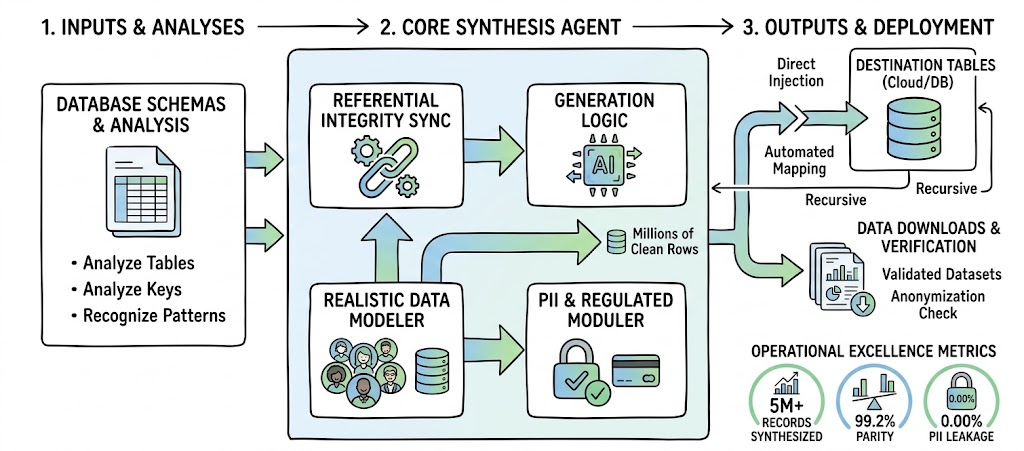
- Synthetic Data Agent (This Agent): Scans your target schemas, implements PII DETECTION, applies ML SYNTHESIS and DIFFERENTIAL privacy constraints, and generates high-fidelity synthetic mock datasets while maintaining perfect referential DATA INTEGRITY and SCHEMA FIDELITY.
- Data Lineage Agent: Gathers metadata from all agents, including the synthesis pipelines defined by the Synthetic Data Agent, to compile a comprehensive, column-level graph of the entire data pipeline.
By combining these specialized agents, the platform automates the entire development and testing lifecycle, protecting systems from downstream failures and ensuring total data privacy.
Platform & Tool Integrations
The Synthetic Data Agent supports a wide array of databases, files, orchestration platforms, and collaboration tools.
Supported Data Sources & Destinations
- Cloud Warehouses: Snowflake, Google BigQuery, Amazon Redshift, and Databricks.
- Relational Databases: PostgreSQL, MySQL, and Microsoft SQL Server.
- Storage Systems: Amazon S3, Google Cloud Storage (GCS), and Azure Data Lake Storage (ADLS).
Orchestration & Testing Frameworks
- Great Expectations: Generates expectation suites to validate the quality and statistical parameters of your synthetic outputs.
- dbt (data build tool): Integrates mock data sources to run local unit test assertions and check mapping models.
- Apache Airflow / Prefect / Dagster: Integrates via task decorators to trigger synthetic data generation and bulk injection steps automatically in your environments.
Collaboration & Chat Integrations
- Teams & Slack: Connect the agent to Microsoft Teams or Slack to request synthetic schemas, trigger mock data generation, and receive status alerts. Contact support on the Datapunkt site to request setup tokens.
Security, Privacy, and Data Protection
We understand that data validation and synthesis involve interacting with sensitive schemas and column values. The Synthetic Data Agent is designed with strict security-first principles to keep your assets safe.
Zero-Data Storage Policy
A core security benefit of the Datapunkt architecture is that we do not store your operational database records:
- The agent only scans metadata, such as table schemas, DDL definitions, or small samples of dummy data provided for profiling.
- The agent never accesses, queries, or stores the actual transactional data rows, client records, or sensitive personal information.
- Your business data remains within your private network boundaries.
Transient In-Memory Processing
To prevent unauthorized metadata access, all profiling, privacy preserving scans, and code generation are executed transiently in memory:
- Generation rules, PII DETECTION flags, and profiling statistics are generated in real-time during your active session.
- Once the session is closed, the in-memory cache is immediately cleared.
- No technical metadata or mapping graphs are saved on our platform databases.
Encryption & Secure Access
- Transit Encryption: All communications between your systems, orchestrators, and the agent are protected using TLS 1.3 encryption.
- Credential Isolation: The agent connects to metadata stores using read-only credentials with minimal access scopes, ensuring it cannot modify schemas or read data rows.
Multi-Region Residency Controls
You can specify the region where the agent instance and session metadata reside to comply with corporate and local regulations:
- United States (US)
- Europe (EU)
- Asia-Pacific (APAC)
- Customer-Specified Location (for custom deployments)
Troubleshooting & Support
Follow these practices to resolve common operational challenges:
Unresolved Field References or Key Collisions
If the generated validation scripts return compilation errors regarding missing fields, verify that the DDL schema provided during the profile phase matches the current state of your physical database table. Ensure that foreign key parent columns contain primary values matching the child keys to keep referential integrity intact.
Generation Timeout on Large Volumes
If you request massive synthetic tables (e.g., > 10M rows) and experience a session timeout, partition your generation requests:
- Divide the synthesis jobs into smaller batches (e.g., 1M rows per run).
- Save the generation seed parameters to ensure consistency.
- Combine the output files in your storage layer.
Technical Support
For custom API configurations, corporate licensing, or private cloud deployment options, contact our support team directly via the Datapunkt site.
Benefits: What Makes It Good?
- Zero-Storage Security Architecture: Only processes schema metadata and samples, ensuring that your sensitive transactional data never leaves your environment.
- Automatic Multi-Agent Sync: Integrates with the entire Datapunkt agent suite, updating your synthesis rules immediately whenever upstream schemas or mapping contracts change.
- Robust Multi-Dimension Protection: Validates and preserves data privacy while ensuring high-fidelity data integrity, schema matching, and compliance configurations.
- Multi-Framework Exports: Generates ready-to-run code for SQL, Python, or Great Expectations, fitting seamlessly into your existing orchestration stack.