
Deep Legal Thinking
At its core, Deep Legal Thinking is the most advanced cognitive reasoning architecture within the Legalpunkt aOS platform. Powered by the next-generation Gemini 3.1 Deep Think reasoning engine, this mode transitions your AI co-counsel from high-speed informational retrieval to deep, deliberative legal intellect.
While standard AI models optimize for instantaneous responses, Deep Legal Thinking engages an extended, multi-stage reasoning process. It operates like an elite senior partner or specialized judicial researcher: methodically dissecting complex factual matrices, testing competing legal hypotheses, stress-testing arguments against adverse interpretations, and synthesizing rock-solid, citation-backed legal deliverables.
What Makes Deep Legal Thinking Different
The distinction between standard conversational AI and Deep Legal Thinking is rooted in deliberative cognitive depth and multi-step reasoning chains.
When you submit a prompt to standard Co-Counsel, the model retrieves context and immediately begins generating a response. Deep Legal Thinking, however, treats your prompt as an intricate legal brief requiring comprehensive analysis. It activates a dedicated "thinking phase" during which it formulates an internal plan, explores alternative interpretations, self-critiques intermediate assumptions, and cross-checks statutory and judicial authority before producing a final conclusion.
Key Cognitive Pillars
- Deliberative Reasoning Architecture ("Thinking Time"): Powered by Gemini 3.1 Deep Think, the model dedicates compute time to deliberate over complex questions. It explores branching paths of reasoning, evaluates edge cases, and self-corrects potential flaws before committing to a single word of output.
- Hierarchical Problem Decomposition: Dense legal problems are systematically broken down into distinct statutory questions, evidentiary prerequisites, and jurisdictional sub-issues, ensuring no subsidiary point is overlooked.
- Adversarial Stress-Testing & Counter-Argument Simulation: The model proactively adopts the posture of opposing counsel, regulatory auditors, or skeptical judges. It challenges its own propositions, identifies vulnerabilities in contract clauses or litigation claims, and formulates pre-emptive counter-strategies.
- Rigorous Authority Reconciliation: When dealing with ambiguous statutes, circuit splits, or conflicting appellate decisions, Deep Legal Thinking weighs the hierarchy of legal norms, assesses precedential weight, and reconciles divergent positions with intellectual precision.
- Structured, Audit-Ready Deliverables: Output is generated as a comprehensive legal brief or memorandum—complete with explicit statutory citations, risk ratings, executive summaries, and actionable strategic recommendations.
When to Apply Deep Legal Thinking
Deep Legal Thinking is engineered for high-stakes, intricate matters where nuanced reasoning and evidentiary accuracy outweigh raw generation speed. Deploy Deep Legal Thinking in the following scenarios:
- Complex Statutory & Regulatory Dissection: When interpreting multifaceted statutory frameworks, navigating conflicting administrative circulars, or analyzing cross-border regulatory compliance (such as GDPR, EU AI Act, cross-border corporate reorganizations, or competition law).
- High-Stakes Litigation & Strategy Formulation: When preparing for oral arguments, drafting appellate briefs, structuring jurisdictional objections, or stress-testing a claim's strengths and weaknesses against adverse case law.
- Multi-Contract & Commercial Risk Synthesis: When auditing interlocking transactional agreements (such as syndicated loan facilities, M&A share purchase suites, or complex licensing ecosystems) where terms across multiple schedules interact and must be harmonized.
- Ambiguous or Conflicting Precedent: When legal authority is split across jurisdictions or appellate courts, and your team needs a reasoned assessment of judicial reasoning patterns and probabilities.
- Client-Ready Legal Memoranda: When you require an exhaustive, citation-rich legal memorandum, risk assessment matrix, or formal opinion letter that can be delivered directly to executive leadership or external clients.
Standard Interaction vs. Deep Legal Thinking
| Dimension | Standard Interaction | Deep Legal Thinking (Gemini 3.1 Deep Think) |
|---|---|---|
| Response Latency | Near-instantaneous (1–5 seconds) | Deliberative (typically 1–3 minutes) |
| Reasoning Architecture | Direct single-pass generation | Multi-step deliberate planning, hypothesis testing & self-correction |
| Handling of Ambiguity | Presents most probable direct answer | Evaluates competing theories, minority views, and jurisdictional nuances |
| Adversarial Critique | Basic risk notation | Comprehensive stress-testing simulating opposing counsel & judicial scrutiny |
| Output Deliverable | Concise summaries, draft snippets, direct Q&A | Exhaustive, structured legal memoranda with rigorous citation hierarchy |
| Ideal Scope | Routine drafting, clause tweaks, quick Q&A | Complex dispute strategy, regulatory audits, high-stakes contract suites |
Using Deep Legal Thinking in the Workspace
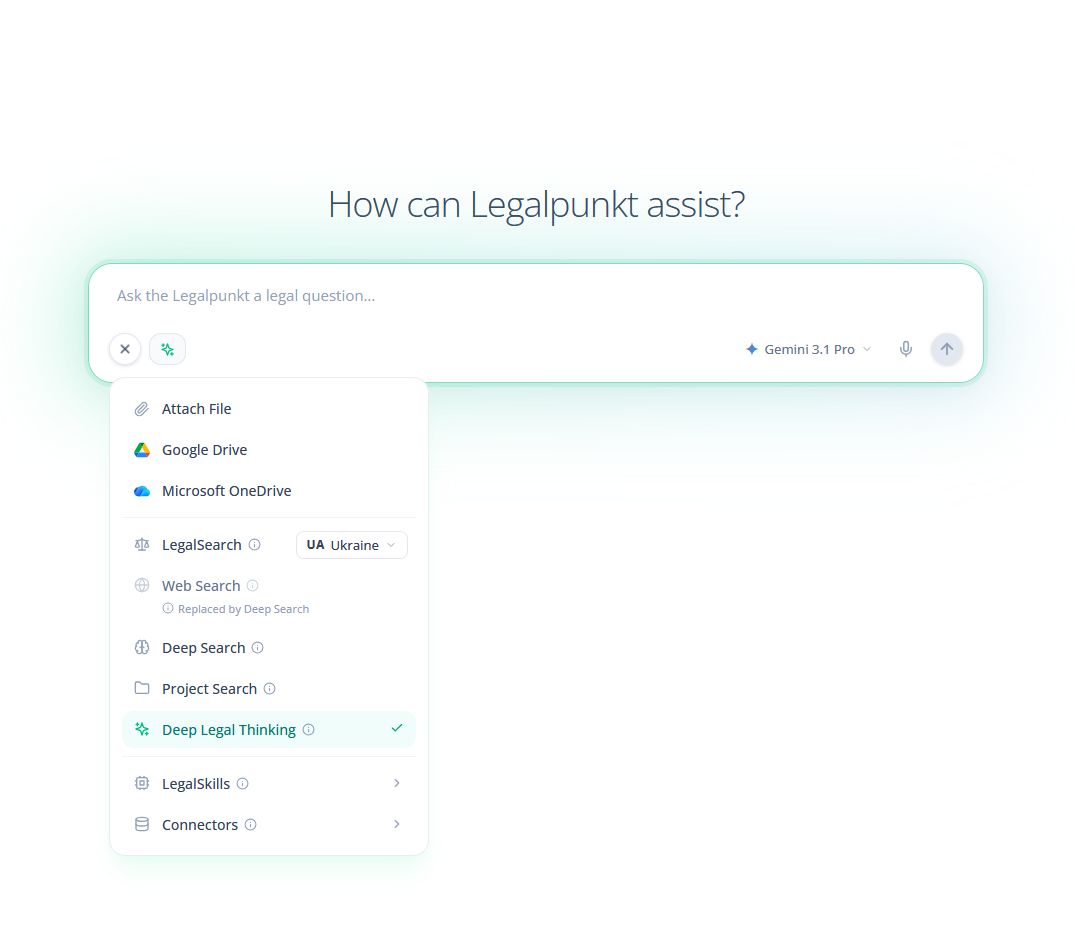
You can activate Deep Legal Thinking in either Global Chat or any active Project Chat:
- Open your workspace (Global Chat or active Project workspace).
- Locate the input bar at the bottom of the screen.
- Click the Plus (+) icon on the left side of the input bar to expand the Sources & Capabilities menu.
- Select the Deep Legal Thinking option (indicated by the Zap icon).
- Enter your comprehensive legal inquiry into the prompt bar and click Send.
NOTE
Because the Deep Legal Thinking engine engages an extended deliberative reasoning phase powered by Gemini 3.1 Deep Think, generation typically takes between 1 to 3 minutes. A live reasoning indicator displays the ongoing phases of analysis, hypothesis validation, and deliverable synthesis in real time.
TIP
Prompting Best Practice: Deep Legal Thinking excels when provided with comprehensive context. Include the full factual background, governing jurisdiction, specific contractual terms, and explicit output constraints (e.g., "Draft an exhaustive 5-part memorandum analyzing the counterparty's breach under UK Commercial Law, actively stress-testing their potential force majeure defenses").