
LegalPunkt Settings: Playbooks
This document explains how to browse, preview, and deploy Playbook Templates — the pre-built collections of contract review rules that define your organization's risk tolerances, negotiation positions, and clause-level compliance standards. This tab serves as the global template library from which you can equip any project with a ready-to-use playbook.
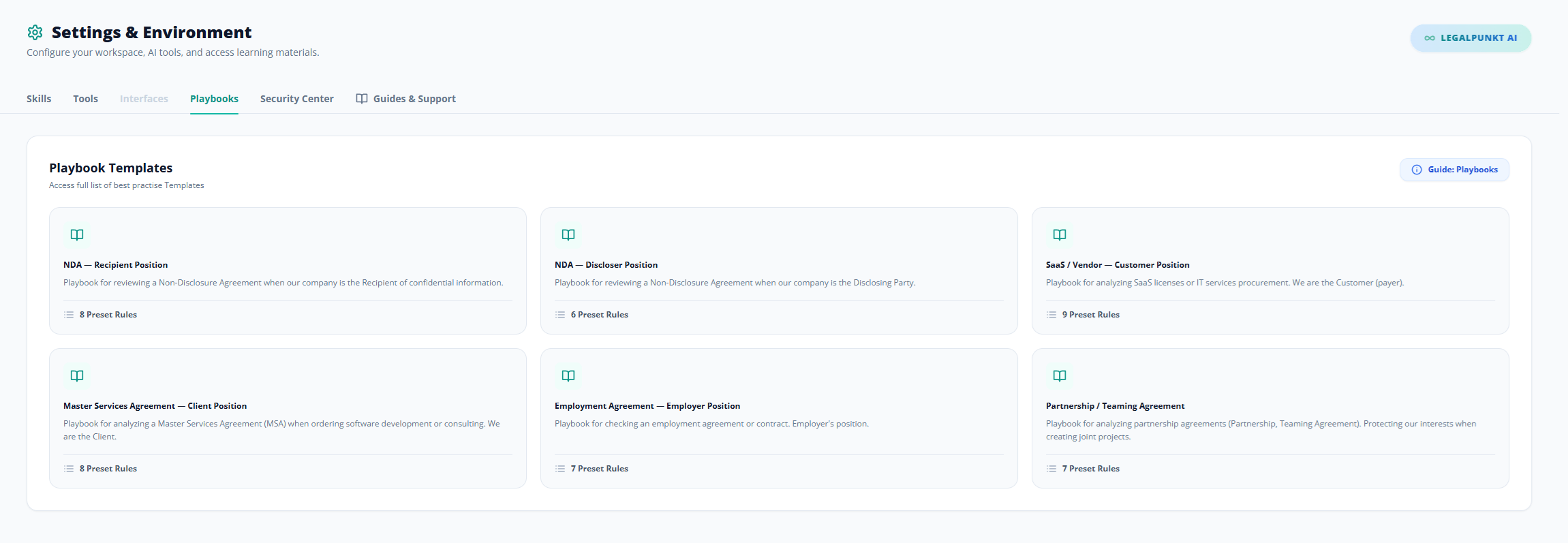
What Are Playbook Templates?
Playbook Templates are pre-configured, reusable frameworks of contract review rules stored at the global Settings level. Each template contains a structured set of rules that define how the AI Agent should evaluate specific types of contracts — specifying what clauses are acceptable, what compromises can be tolerated, and what positions are absolute deal-breakers.
Globally Sourced Expertise for Cross-Border Jurisdictions
These templates are not just generic legal boilerplate. We have actively collected, synthesized, and organized unique legal knowledge, market standards, and battle-tested negotiation playbooks from top-tier legal practitioners and industry leaders across the world.
Through these playbook templates, we share this global expertise directly with you. Every template is specifically designed with jurisdictional adaptability in mind. Whether you are dealing with common law nuances in the United States (US), strict regulatory harmonization in the European Union (EU), or the rapidly evolving commercial and digital frameworks in Ukraine (such as Diia City regimes and local Civil/Economic Codes), these playbooks are built to pivot and scale to match your local or cross-border needs.
The Templates Dashboard & Deep-Dive Directory
Our curated global library includes six core templates, highly optimized for international standards and local jurisdictional compliance. Below is a detailed breakdown of what each template contains and exactly when you should deploy them.
1. Standard Vendor Playbook
Overview & Rule Count
- Rule Count: 12 preset rules covering liability limits, standard mutual and unilateral indemnification, governing law preferences, payment terms, and termination rights.
- Jurisdictional Adaptability: Pre-configured to easily toggle between US state-level uniform commercial codes, EU civil law liability ceilings, and Ukrainian Economic Code mandatory provisions.
Deep-Dive Description
This playbook serves as your foundational shield for routine commercial transactions. It sets realistic, balanced boundaries for buying standard services and goods without dragging your legal team into endless bespoke negotiations. It contains rules designed to flag aggressive indemnification demands, unreasonable payment schedules (e.g., net-90 terms), and hidden automatic renewal clauses.
When to Use This Playbook
- Standard Procurement: Use this whenever your sourcing or procurement team is purchasing off-the-shelf physical products, standard consulting services, or hiring external corporate agencies.
- Vendor-Provided "Paper": Deploy this immediately when a vendor insists on using their own contract template instead of your standard corporate terms. It will rapidly flag where the vendor’s terms deviate from balanced market standards.
- Low-to-Medium Risk Commercial Deals: Ideal for fast-tracking agreements where the transaction value is moderate, and you want to ensure basic protections (such as mutual waiver of consequential damages and reasonable caps on liability) are locked in without manual drafting.
2. Employment NDAs
Overview & Rule Count
- Rule Count: 8 preset rules covering strict confidentiality parameters, definition of proprietary information, intellectual property (IP) assignment defaults, return/destruction of materials, and non-compete/non-solicit limitations.
- Jurisdictional Adaptability: Tailored for complex regulatory splits: US rules align with state-level limitations on non-compete clauses (such as FTC guidelines and California policies); EU rules respect strict local labor protection statutes; Ukrainian configurations explicitly support the Diia City legal regime, ensuring compliant gig-contracts, specialized NDA enforceability, and robust employer-owned IP transfer mechanisms.
Deep-Dive Description
Protecting trade secrets begins on day one of a team member's onboarding. This playbook focuses heavily on safeguarding your intellectual assets while maintaining a fair, legally enforceable relationship with staff. It guards against overreaching restrictive covenants that could invalidate the contract in court, while ensuring that all IP developed during the engagement is flawlessly assigned to the company.
When to Use This Playbook
- New Hire Onboarding: Use this during the recruitment and onboarding phases for full-time, part-time, or executive-level employees.
- Independent Contractors & Gig Workers: Deploy this when engaging external freelancers, software development agencies, or specialized individual consultants where IP creation is a primary output.
- Corporate Restructuring or Transition: Ideal when standardizing employment documentation across newly acquired subsidiaries or setting up new regional operations in the US, EU, or Ukraine.
3. SaaS Licensing Agreement
Overview & Rule Count
- Rule Count: 24 preset rules covering software-as-a-service delivery models, data security standards, service level agreements (SLAs) and uptime guarantees, software warranty exclusions, subscription renewal mechanisms, and regulatory compliance.
- Jurisdictional Adaptability: Addresses global cloud hosting realities, including EU-specific localization rules (e.g., Schrems II implications), US cloud security certifications (like SOC 2 compliance), and Ukrainian tax and digital service compliance.
Deep-Dive Description
SaaS procurement demands specialized oversight because you are trusting an external vendor with your operational infrastructure and, frequently, your data. This extensive playbook provides granular rules to evaluate data ownership, exit strategies (how easily you can extract your data if you cancel), service availability credits, and vendor audit rights over your usage.
When to Use This Playbook
- Procuring Cloud Infrastructure & Software: Use this when purchasing enterprise SaaS systems, CRM platforms, cloud hosting spaces, or collaborative digital tools.
- Selling Your Own SaaS (Customer Reviews): If your organization is a SaaS vendor, deploy this to evaluate incoming customer redlines, helping your sales desk identify acceptable compromises on SLAs, data handling, and liability.
- High-Tech Partnerships: Perfect for software integrations, API licensing agreements, or white-label technology partnerships.
4. M&A Due Diligence
Overview & Rule Count
- Rule Count: 18 preset rules covering corporate change-of-control provisions, transfer and assignability restrictions, survival periods of representations and warranties, employee transfer implications, and post-closing liabilities.
- Jurisdictional Adaptability: Evaluates agreements under complex corporate laws, handling US Delaware-court standards, EU-specific automatic labor transfers (TUPE regulations), and statutory limits on corporate authorizations or shareholder controls in Ukraine.
Deep-Dive Description
During mergers, acquisitions, or investment rounds, reviewing historical and active contracts for "red flag" clauses is critical. This playbook acts as an automated due diligence assistant, scanning third-party agreements to identify hidden traps such as "change of control" clauses that allow the other party to terminate the contract upon your acquisition, or restrictive assignability clauses that block the smooth transfer of assets.
When to Use This Playbook
- Pre-Acquisition Audits (Buy-Side): Deploy this to audit the target company’s entire contract portfolio to quickly highlight hidden liabilities, termination risks, or restrictive covenants.
- Investment & Venture Capital Rounds: Use this when preparing your company for external investment or joint ventures, ensuring your own contract portfolio is clean and attractive to incoming investors.
- Corporate Restructuring: Perfect for internal corporate reorganizations where asset assignments, subsidiary mergers, or IP transfers are taking place.
5. Data Processing Agreement (DPA)
Overview & Rule Count
- Rule Count: 15 preset rules strictly covering Standard Contractual Clauses (SCCs), technical and organizational security measures (TOMs), sub-processor transparency and approval pipelines, mandatory data breach notification timeframes, and audit rights.
- Jurisdictional Adaptability: Deeply aligned with the EU General Data Protection Regulation (GDPR), UK GDPR, emerging US state privacy laws (such as CCPA/CPRA), and the Ukrainian Law "On Protection of Personal Data" (specifically managing international transfers and state registrations).
Deep-Dive Description
A DPA is an absolute legal necessity whenever personal data is shared with or processed by third parties. This playbook ensures that your DPAs are highly compliant, monitoring for aggressive terms where processors try to limit their liability for data breaches or reserve the right to hire sub-processors without your prior notification. It locks in strict security benchmarks and quick-turnaround breach notification timelines.
When to Use This Playbook
- Vendor Onboarding Involving Customer Data: Use this whenever a tool or service you are buying will touch, store, or process personal data of your customers or employees.
- Negotiating Client-Facing DPAs: If you are a B2B service provider handling client data, use this to evaluate incoming customer-drafted DPAs, helping you maintain operational reality in your security commitments.
- Cross-Border Data Transfers: Essential when setting up transfer mechanisms (such as SCCs or adequacy-based frameworks) between different jurisdictions like the US, EU, and Ukraine.
6. Real Estate Lease
Overview & Rule Count
- Rule Count: 10 preset rules focusing on commercial and residential lease provisions, wartime and emergency force majeure adaptations, maintenance/structural repair liabilities, subletting/assignment permissions, and rent adjustment indexes.
- Jurisdictional Adaptability: Incorporates EU landlord-tenant protections, US commercial real estate triple net (NNN) and gross lease standards, and Ukrainian Civil Code real estate rules—including specific, battle-tested force majeure guidelines adjusted for martial law and local operating environments.
Deep-Dive Description
Real estate leases are historically heavily weighted in favor of landlords. This playbook helps commercial tenants balance the scales, targeting unfair maintenance allocations, restrictive sublease policies that block you from optimizing empty desk space, and unstable force majeure clauses that fail to protect your business during periods of regional conflict or state emergencies.
When to Use This Playbook
- Commercial Office Leasing: Use this when negotiating new office space, co-working memberships, or corporate headquarters.
- Industrial & Warehousing Leases: Deploy this when renting logistics centers, warehouses, or manufacturing facilities, where maintenance obligations and structural liabilities are critical.
- Retail & Branch Network Expansion: Ideal for businesses opening physical retail stores or local branches, ensuring lease terms across different regions remain standardized and safe.
Deploying a Template to a Project
Once you have found the right template, deploying it to a project is straightforward:
- Open the template by clicking its card on the Templates dashboard.
- In the Template Detail View, click the Use Template in Project button (teal) in the top navigation bar.
- Select the target project from the dropdown or dialog that appears.
- The template's rules will be copied into the selected project's Playbooks tab.
- Navigate to the project to begin customizing the rules for your specific deal, if needed.
Note: The original template in Settings remains unchanged. Any modifications you make within a project's playbook are local to that project and do not affect the global template.
Best Practices for Playbook Template Management
- Start with a template, then customize. It is much faster to deploy an existing template and adjust a few rules than to build a playbook from scratch. Use templates as starting points and refine them to match the specifics of each deal.
- Create templates for recurring deal types. If your organization frequently handles a specific type of agreement (e.g., SaaS vendor contracts), build a dedicated template once and reuse it across all relevant projects.
- Keep rationales current. The Firm Rationale section is one of the most valuable parts of each rule — it preserves institutional knowledge about why specific positions were adopted. Review and update rationales when your organization's policies change.
- Leverage precedents for onboarding. New team members can read through the Traceability & Precedents section to understand the historical context behind each rule, accelerating their ramp-up on firm standards.
- Use AI Extraction Instructions thoughtfully. The AI Instructions section directly controls how the agent analyzes contracts. Write clear, specific instructions that tell the agent exactly what to flag and at what threshold.